

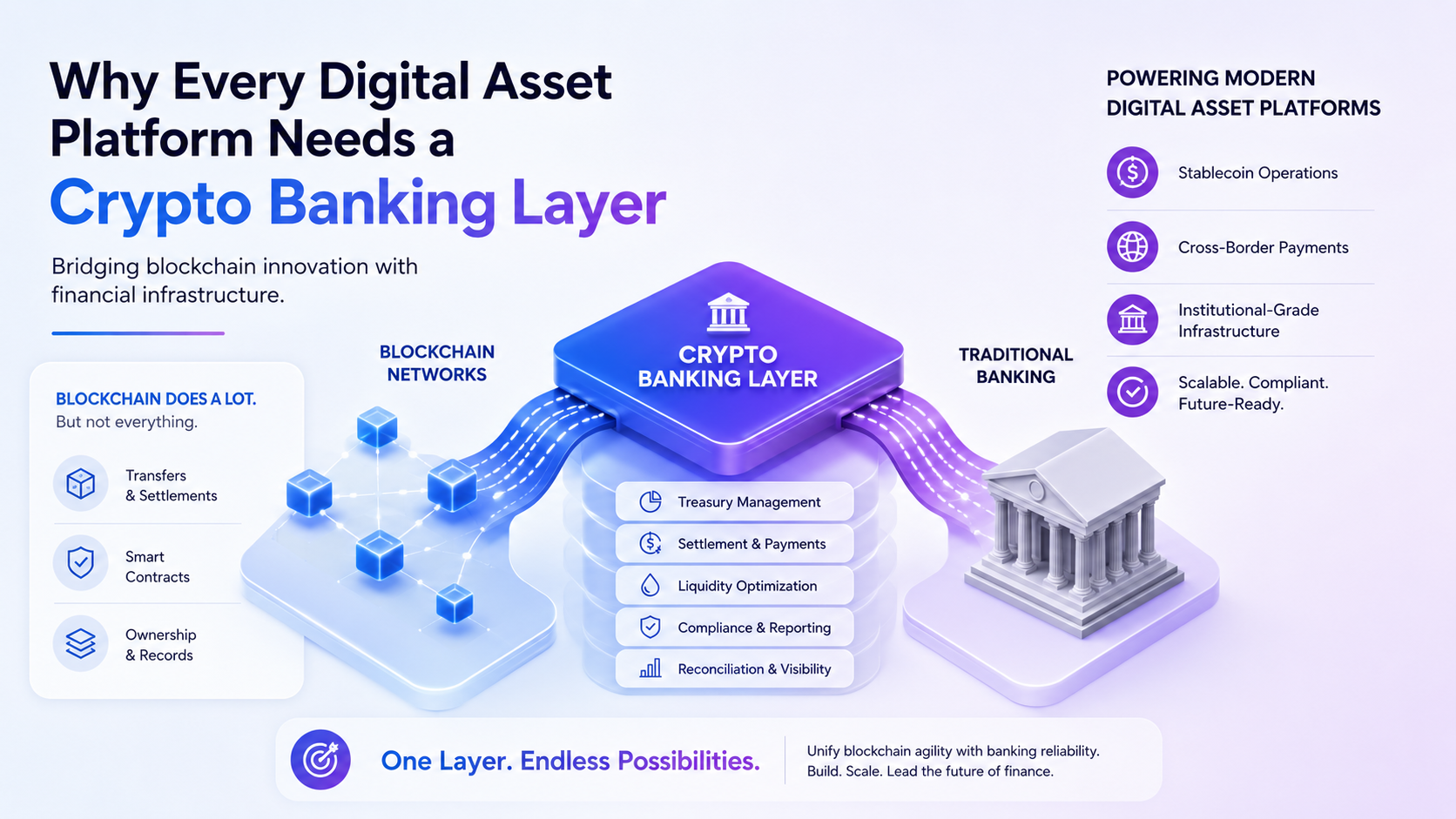
The digital asset industry has evolved far beyond cryptocurrency trading. Today, platforms are expected to support tokenized real-world assets (RWAs), institutional custody, stablecoin payments, cross-border transfers, digital wallets, and programmable financial services. As these offerings expand, digital asset businesses begin operating much like financial institutions, even if their foundation is built on blockchain technology.
This evolution introduces a challenge that blockchain alone cannot solve. While distributed ledgers are excellent for recording ownership and transferring digital assets, they do not manage treasury operations, banking relationships, fiat settlements, liquidity allocation, or financial reporting. As platforms scale, these functions become increasingly interconnected, making a unified financial infrastructure essential. This is why many digital asset businesses eventually require a CRYPTO BANKING LAYER—a framework that bridges blockchain networks with traditional banking systems while streamlining financial operations.
Blockchain Infrastructure Solves Only Part of the Financial Equation
Blockchain technology has transformed how value is transferred by enabling decentralized, transparent, and programmable transactions. It allows businesses to issue digital assets, automate settlements through smart contracts, and maintain tamper-resistant records without relying on centralized intermediaries.
However, running a successful digital asset platform involves much more than processing blockchain transactions. Businesses must still accept customer bank transfers, settle payments in fiat currency, reconcile financial records, manage corporate treasury, process vendor payments, and comply with regulatory requirements. These responsibilities continue to depend on conventional financial infrastructure.
Rather than replacing banking systems, blockchain complements them. As a result, digital asset platforms eventually operate across two distinct financial environments that must work together efficiently.
Operational Complexity Increases as Platforms Grow
A startup exchange or wallet provider can initially rely on separate tools for custody, payments, compliance, and accounting. This approach often works during the early stages because transaction volumes are relatively low and operational processes remain manageable.
Growth changes that equation quickly. As platforms add support for multiple blockchain networks, expand into new markets, onboard institutional customers, and introduce additional financial products, every new service adds another operational layer. Instead of managing isolated blockchain transactions, businesses begin coordinating activities across banks, custodians, payment providers, compliance systems, and internal finance teams.
Without centralized financial coordination, platforms commonly encounter challenges such as:
- Reconciling blockchain transactions with bank account balances.
- Managing liquidity across multiple wallets, custodians, and financial institutions.
- Coordinating settlements involving both fiat and digital assets.
- Synchronizing customer balances across different internal systems.
- Producing consistent financial and regulatory reports.
- Reducing operational risks caused by disconnected workflows.
These issues rarely appear overnight, but they become increasingly difficult to ignore as transaction volumes and business operations expand.
What a Crypto Banking Layer Actually Does?
A crypto banking layer is not another wallet or blockchain application. Instead, it serves as the operational infrastructure that connects blockchain-based financial activity with traditional banking systems, allowing different financial processes to function as part of a unified ecosystem.
Its responsibilities typically extend across several operational areas.
Treasury Management
Digital asset businesses often hold capital across exchanges, custodians, operational wallets, stablecoin reserves, and bank accounts. A crypto banking layer provides a centralized view of these assets, helping finance teams monitor liquidity and allocate capital more efficiently.
Settlement Coordination
Many customer transactions involve both blockchain networks and banking rails. For example, a customer may deposit fiat through a bank account, purchase tokenized assets, receive stablecoins, and later redeem them back into traditional currency. Coordinating these activities requires seamless interaction between banking infrastructure and blockchain systems.
Liquidity Management
Supporting several blockchain ecosystems creates new liquidity challenges. Customer demand may shift rapidly between Ethereum, Solana, Polygon, or Layer-2 networks, requiring platforms to rebalance assets continuously. A crypto banking layer helps optimize liquidity without leaving excessive capital idle across different networks.
Financial Reconciliation
Accurate financial reporting depends on reconciling blockchain records, internal ledgers, customer balances, banking transactions, and accounting systems. Automating these reconciliation processes reduces operational errors while improving transparency across the organization.
Stablecoins Have Added New Banking Responsibilities
Stablecoins are often viewed as a bridge between traditional finance and blockchain technology, but supporting them at scale introduces considerable operational complexity. Businesses must maintain liquidity across multiple blockchain networks while coordinating reserve management, settlement timing, transaction fees, and banking relationships.
The challenge becomes even greater when platforms support several stablecoins across different ecosystems. Each blockchain has unique settlement speeds, transaction costs, and liquidity conditions, requiring continuous monitoring and capital allocation.
Instead of simplifying financial operations, stablecoins increase the importance of treasury coordination and settlement management. A crypto banking layer helps orchestrate these moving parts, ensuring funds remain available where customers need them while maintaining efficient interaction between digital assets and fiat infrastructure.
Institutional Clients Expect Banking-Grade Operations
Institutional adoption has significantly raised the operational standards for digital asset platforms. Asset managers, corporate treasuries, family offices, and financial institutions evaluate infrastructure based not only on blockchain capabilities but also on governance, transparency, and operational reliability.
To meet these expectations, platforms increasingly require capabilities such as:
- Multi-level approval workflows for large transactions.
- Segregated client accounts and asset management.
- Automated settlement and reconciliation processes.
- Real-time treasury visibility across all financial assets.
- Comprehensive audit trails and transaction history.
- Regulatory reporting and compliance monitoring.
These features are common within traditional banking environments because they reduce operational risk and improve accountability. As institutional participation grows, digital asset platforms must provide similar operational standards alongside blockchain functionality.
Compliance Is Becoming Part of Financial Infrastructure
Regulatory expectations for digital assets continue to evolve, but one trend remains consistent: Compliance is moving closer to the core of financial operations. Rather than reviewing transactions after they occur, businesses are expected to integrate compliance throughout the transaction lifecycle.
This typically includes:
- Customer identity verification during onboarding.
- AML and sanctions screening before transactions are processed.
- Continuous monitoring for suspicious activity.
- Risk assessment of customers and counterparties.
- Automated recordkeeping for audits and reporting.
- Regulatory reporting across multiple jurisdictions.
Embedding these functions directly into operational workflows improves consistency while reducing manual intervention and processing delays.
The Future Depends on Financial Interoperability
The next stage of digital asset adoption will depend less on faster blockchains and more on how effectively different financial systems interact. Businesses increasingly need to move value between bank accounts, stablecoins, tokenized assets, payment networks, and blockchain ecosystems without creating operational friction.
A crypto banking layer provides the infrastructure that enables this interoperability. Rather than replacing banks or competing with blockchain networks, it coordinates financial activity across both environments, allowing digital asset platforms to scale without relying on fragmented operational processes.




No Comment