

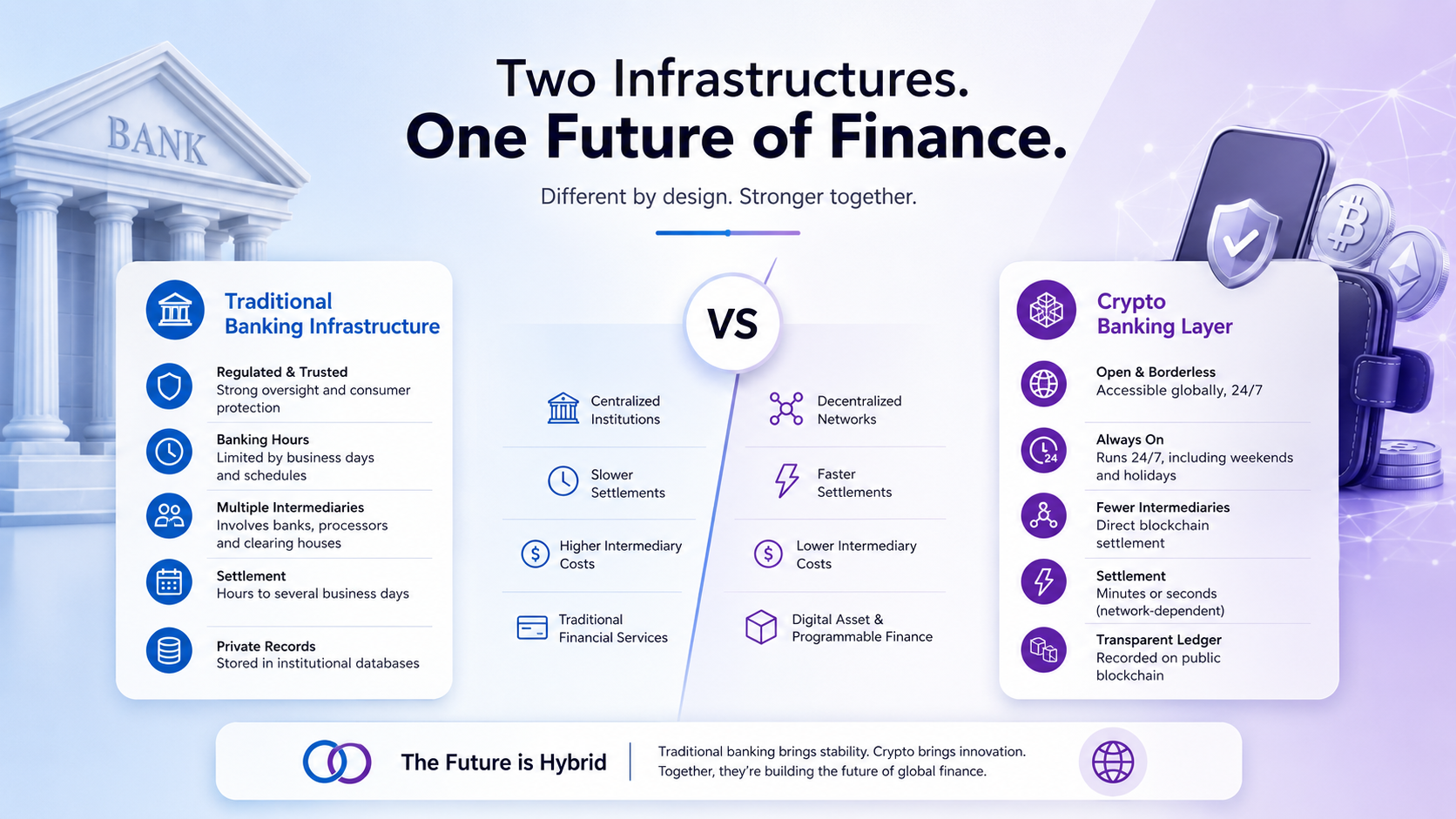
The way money moves around the world is changing. For decades, traditional banking infrastructure has powered everything from salary deposits and business loans to international wire transfers. It remains the foundation of the global financial system, trusted by billions of people and businesses every day.
At the same time, blockchain technology has introduced a new financial model known as the crypto banking layer. Rather than depending entirely on banks and payment intermediaries, this approach uses blockchain networks to transfer, settle, and manage digital assets.
Although these two systems often appear to compete with one another, they are built to solve different challenges. Understanding how they work – and where each one excels – can help individuals and businesses make better financial decisions in an increasingly digital economy.
Understanding Traditional Banking Infrastructure
Traditional banking infrastructure is the network of institutions and systems that allow money to move securely between individuals, businesses, and governments. Behind every payment is a chain of banks, payment processors, clearing houses, regulators, and settlement systems working together to complete a transaction.
Most customers never see this process because it happens in the background. Whether you swipe a debit card, receive a salary, or send an international payment, multiple organizations may verify, process, and settle that transaction before the funds officially arrive.
Some of its biggest strengths include:
- Strong regulatory oversight.
- Consumer protection and fraud monitoring.
- Well-established lending and credit systems.
- Global acceptance across businesses and financial institutions.
The trade-off is that this multi-layered system can sometimes be slower and more expensive, particularly for cross-border payments that involve several intermediary banks.
What Is a Crypto Banking Layer?
A crypto banking layer isn’t a bank in the traditional sense. Instead, it is a blockchain-based financial ecosystem that enables users to store, transfer, and manage digital assets without relying entirely on conventional banking rails.
Transactions are validated through distributed blockchain networks instead of centralized financial institutions. Every verified transaction is recorded on a shared ledger, creating transparency while reducing the need for multiple intermediaries.
Today, many crypto banking platforms also offer services that resemble traditional banking, including:
- Digital wallets.
- Stablecoin payments.
- Asset custody.
- Crypto-backed lending.
- Cross-border payment solutions.
Rather than replacing banks altogether, these services introduce an alternative settlement infrastructure that operates alongside existing financial systems.
Comparing the Core Infrastructure
The biggest difference between these systems lies in how trust is established.
Traditional banking depends on regulated institutions to verify identities, authorize transactions, and maintain financial records. Customers place their trust in banks, which are supervised by financial regulators.
Crypto banking shifts much of that trust toward blockchain technology. Instead of a central authority validating every transaction, distributed networks confirm transactions according to predefined protocol rules.
The differences become easier to understand when viewed side by side.
|
Feature |
Traditional Banking Infrastructure |
Crypto Banking Layer |
|
Transaction validation |
Banks and financial institutions |
Blockchain consensus mechanisms |
|
Operating hours |
Often limited by banking schedules |
Available 24/7 |
|
Settlement |
Hours to several business days | Minutes or seconds (network-dependent) |
|
Record keeping |
Private institutional databases |
Public blockchain ledger |
|
Intermediaries |
Multiple parties |
Significantly fewer |
Neither model is inherently better – they simply prioritize different approaches to moving and securing financial value.
Speed and Settlement
Transaction speed is one of the most noticeable differences between the two infrastructures.
Traditional bank transfers often pass through several processing stages before settlement is complete. Domestic payments may clear within hours, while international transfers can take several business days depending on the countries and institutions involved.
Blockchain networks, on the other hand, operate continuously. Transactions can be processed at any time, regardless of weekends, holidays, or banking hours.
That doesn’t necessarily mean every crypto transaction is instant. Network congestion, transaction fees, and blockchain scalability can still affect processing times. Even so, continuous settlement remains one of blockchain’s most distinctive advantages.
Comparing Costs
Every financial system comes with operational costs, but those costs arise from different sources.
Traditional banking supports large institutional networks, regulatory compliance, payment processors, and correspondent banking relationships. These operational expenses often translate into service charges for customers.
Crypto banking reduces some intermediary costs by allowing transactions to settle directly on blockchain networks. However, blockchain transaction fees, custody services, and cybersecurity infrastructure introduce their own expenses.
A simple comparison highlights these differences.
|
Expense Area |
Traditional Banking |
Crypto Banking |
|
International transfers |
Often higher | Often lower (depending on the network) |
|
Settlement costs |
Multiple intermediaries |
Direct blockchain settlement |
|
Processing fees |
Institutional service charges |
Network transaction fees |
|
Infrastructure |
Centralized institutions |
Distributed blockchain networks |
Ultimately, the cheaper option depends on the size, location, and purpose of the transaction.
Security: Two Different Approaches
Security is a priority for both systems, but they achieve it in different ways.
Traditional Banking
Banks invest heavily in fraud prevention, cybersecurity, customer authentication, insurance protections, and regulatory compliance. If fraudulent activity occurs, customers usually have established dispute resolution processes available.
Crypto Banking
Blockchain networks rely on cryptography instead of centralized oversight. Ownership is controlled through private keys, meaning users take greater responsibility for protecting access to their assets.
While blockchain technology itself has proven highly resilient, surrounding infrastructure such as exchanges, wallets, and smart contracts still requires strong security practices.
Regulation Continues to Evolve
Traditional banking operates within mature regulatory frameworks that have developed over many decades. Financial institutions must comply with licensing requirements, anti-money laundering regulations, capital standards, and customer verification rules.
Crypto banking is following a different path. Around the world, regulators are gradually introducing clearer frameworks for digital assets, stablecoins, crypto exchanges, and blockchain-based financial services.
Rather than separating completely from traditional finance, many crypto businesses are adapting to meet regulatory expectations while banks continue exploring blockchain technology for their own operations.
Is One Better Than the Other?
The answer depends on what the user needs.
Traditional banking remains the preferred choice for:
- Everyday banking services.
- Loans and mortgages.
- Consumer protection.
- Established payment networks.
- Regulatory certainty.
Meanwhile, crypto banking offers clear advantages in areas such as:
- Borderless payments.
- Continuous settlement.
- Digital asset management.
- Programmable financial services.
- Blockchain-based applications.
Instead of replacing one another, both infrastructures are increasingly being used together.
The Rise of Hybrid Finance
Perhaps the biggest misconception is that crypto banking is trying to eliminate traditional banks. In reality, many financial institutions are already adopting blockchain technology to improve settlement, reduce operational costs, and explore tokenized assets.
Likewise, crypto platforms are investing more heavily in compliance, identity verification, and institutional-grade security to build greater trust.
This gradual convergence suggests that the future of finance is unlikely to belong exclusively to one model. Instead, traditional banking infrastructure and crypto banking layers are evolving into complementary parts of a more connected financial ecosystem.
Final Thoughts
The comparison between crypto banking layers and traditional banking infrastructure is less about choosing a winner and more about understanding two different approaches to financial services.
Traditional banking delivers stability, regulation, and broad consumer protections that have been refined over decades. Crypto banking introduces faster settlement, greater transparency, and programmable financial capabilities made possible through blockchain technology.
As digital finance continues to evolve, businesses and consumers are likely to interact with both systems rather than replacing one with the other. The future of global finance will not be defined by traditional banking or crypto banking alone – it will be shaped by the strengths each brings to an increasingly interconnected financial world.



No Comment