

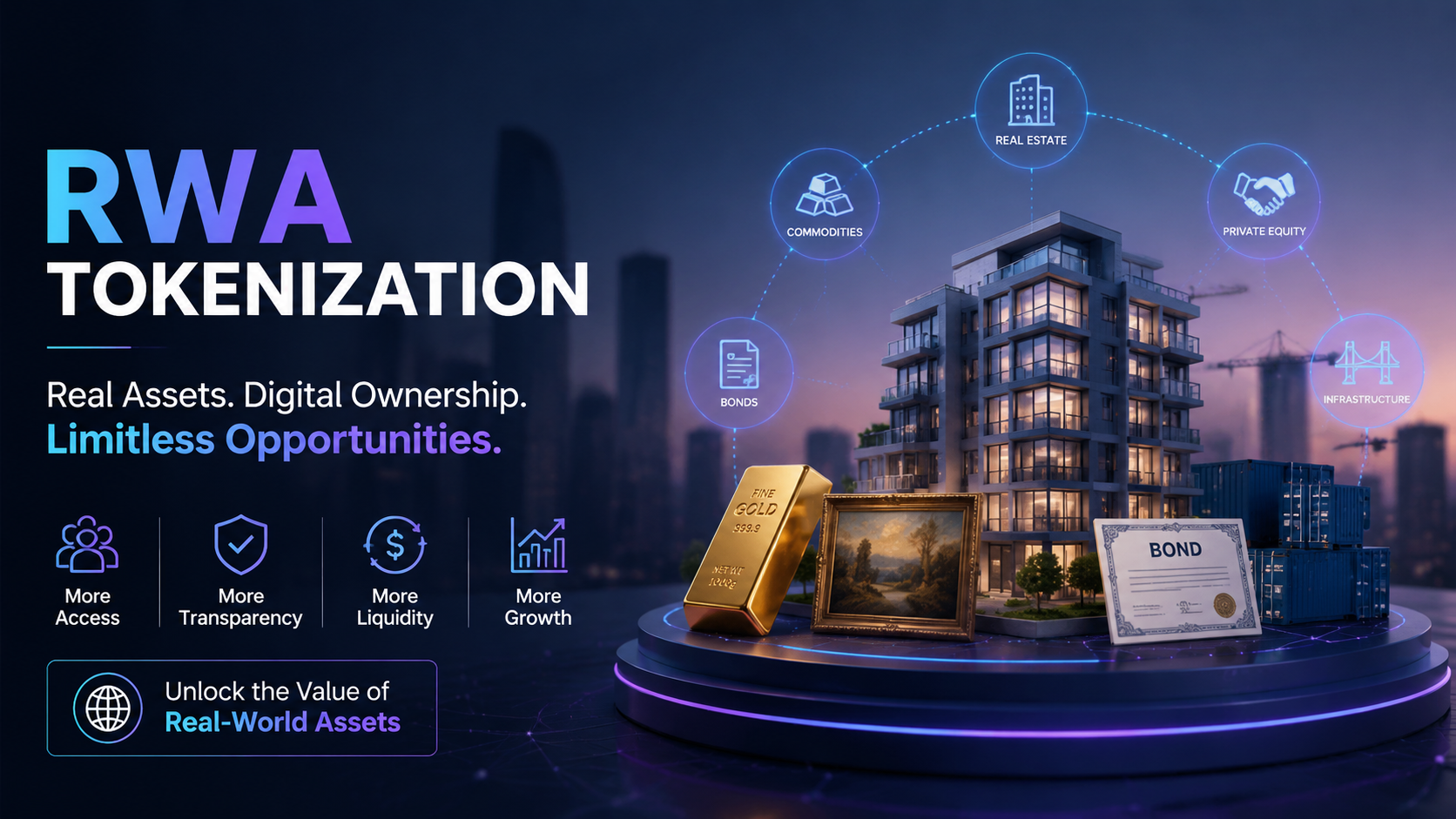
Real-world asset (RWA) tokenization is the process of representing ownership rights to physical or traditional financial assets as digital tokens on a blockchain. Assets such as real estate, government bonds, commodities, invoices, private equity, and fine art can all be tokenized. While the concept is straightforward, the underlying technology is built on several interconnected layers that work together to ensure security, transparency, compliance, and efficient asset management.
Understanding this technology stack helps explain how tokenization platforms transform conventional assets into blockchain-based digital representations.
1. Asset Identification and Verification Layer
Every tokenized asset begins with verification.
Before an asset can be represented digitally, the platform must establish that the asset exists, determine its ownership, evaluate its value, and verify that it can legally be tokenized. This process involves collecting documentation such as ownership records, legal agreements, valuation reports, insurance certificates, or financial statements.
For example, if a commercial building is being tokenized, the platform must first verify the property’s legal title, ownership structure, market valuation, and any outstanding liabilities before digital tokens can represent ownership interests.
Without proper asset verification, the blockchain merely stores inaccurate information permanently.
2. Legal and Compliance Framework
Unlike cryptocurrencies that may exist independently of physical assets, RWAs are connected to legal ownership and financial regulations.
The compliance layer ensures that tokenized assets satisfy applicable legal requirements. This includes:
- Identity verification (KYC)
- Anti-money laundering (AML) checks
- Investor eligibility
- Jurisdiction-specific regulations
- Ownership documentation
- Transfer restrictions where required
This layer determines who can purchase, hold, or transfer certain tokens.
For instance, some investment products may only be available to accredited investors. The platform enforces these restrictions before any blockchain transaction occurs.
3. Tokenization Engine
The tokenization engine converts verified asset ownership into blockchain-compatible digital tokens.
This component defines:
- Total token supply
- Fractional ownership rules
- Ownership percentages
- Transfer permissions
- Dividend or revenue distribution logic
- Redemption mechanisms
Suppose a property worth $10 million is divided into one million tokens.
Each token represents 0.0001% ownership of the property. Investors purchasing 50,000 tokens effectively own 5% of the asset according to the platform’s predefined ownership structure.
The tokenization engine creates these digital ownership units while preserving the asset’s defined ownership model.
4. Smart Contract Layer
Smart contracts automate many of the operational processes involved in tokenized assets.
Rather than relying on manual administration, smart contracts execute predefined rules whenever specified conditions are met.
Common smart contract functions include:
- Token issuance
- Ownership transfers
- Dividend distribution
- Interest payments
- Voting rights
- Redemption requests
- Compliance checks
- Asset lifecycle management
For example, imagine a tokenized corporate bond paying interest every six months.
Instead of calculating and distributing payments manually, a smart contract can automatically allocate interest payments to token holders based on the number of tokens owned on the payment date.
Automation reduces operational complexity while ensuring rules are executed consistently.
5. Blockchain Network
The blockchain serves as the shared ledger where all token-related transactions are permanently recorded.
Every transfer, issuance, redemption, or ownership update becomes part of an immutable transaction history.
The blockchain provides several important characteristics:
- Transparency
- Immutability
- Distributed record keeping
- Traceable ownership history
- Transaction verification
For example, if ownership of a tokenized gold asset changes ten times over several years, the blockchain maintains a chronological record of every transfer without altering previous entries.
This creates a verifiable ownership trail that authorized participants can inspect.
6. Digital Wallet Infrastructure
Digital wallets store the cryptographic credentials that control token ownership.
Unlike traditional investment accounts, blockchain ownership is managed through private keys associated with wallet addresses.
Wallet infrastructure enables users to:
- Hold tokenized assets
- Send tokens
- Receive tokens
- Approve transactions
- View portfolio balances
Institutional platforms often support both self-custody and third-party custodial solutions depending on regulatory and operational requirements.
Regardless of custody model, the wallet functions as the access point to blockchain-based ownership.
7. Oracle Integration
Blockchains cannot directly access external information.
Oracles bridge this gap by supplying verified off-chain data to smart contracts.
Examples of oracle data include:
- Market prices
- Interest rates
- Exchange rates
- Commodity prices
- Property valuations
- Corporate actions
- Maturity dates
Consider a tokenized commodity fund whose value depends on the daily price of gold.
An oracle continuously supplies updated market prices to the smart contract, allowing valuations and settlement calculations to reflect current market conditions.
Without reliable external data, many real-world financial applications would be impossible to automate accurately.
8. Trading and Settlement Layer
Once tokens have been issued, investors require a mechanism to buy, sell, or transfer ownership.
The trading layer facilitates these transactions while the settlement layer finalizes ownership changes on the blockchain.
This layer manages:
- Order matching
- Transaction execution
- Ownership updates
- Settlement confirmation
- Record synchronization
For example, when one investor sells tokenized treasury securities to another, the platform records the trade, updates ownership records, and settles the transaction through blockchain validation.
The settlement process eliminates many manual reconciliation steps found in traditional financial markets.
9. Asset Management Dashboard
Users interact with tokenization platforms through application interfaces rather than directly with blockchain protocols.
These dashboards provide visibility into:
- Portfolio holdings
- Token balances
- Transaction history
- Asset performance
- Distribution records
- Voting events
- Compliance status
For asset issuers, dashboards also support token issuance, investor management, reporting, and lifecycle administration.
This application layer makes blockchain infrastructure accessible without requiring users to understand its underlying technical complexity.
How the Entire Stack Works Together
Each layer performs a specific function while depending on the others.
An asset is first verified and legally structured. The tokenization engine creates digital ownership units based on that verified asset. Smart contracts define how those tokens behave, while the blockchain records every transaction permanently. Digital wallets enable ownership, oracles provide external market information, trading infrastructure facilitates transactions, and dashboards allow users to interact with the entire system through intuitive interfaces.
Consider a tokenized office building as an example. After ownership documents are verified, one million digital tokens are issued. Investors complete identity verification before purchasing tokens through a trading platform. Ownership is stored in digital wallets, rental income distributions are automatically executed by smart contracts, property valuation updates are supplied through oracles, and every ownership transfer is permanently recorded on the blockchain. Investors can monitor their holdings through a dashboard without interacting directly with blockchain protocols.
Conclusion
RWA tokenization platforms are not built around blockchain alone. They combine legal verification, compliance systems, tokenization engines, smart contracts, blockchain networks, wallet infrastructure, external data feeds, trading systems, and user-facing applications into a unified technology stack. Each component addresses a specific requirement, and altogether they therefore enable traditional assets to be represented, managed, transferred, and administered digitally while maintaining transparent ownership records and automated operational processes.

No Comment