


Launching a cryptocurrency exchange from scratch is a major technology undertaking. Businesses need to build or integrate a matching engine, order book, wallet infrastructure, liquidity, security systems, KYC/AML processes, administrative tools, and customer-facing applications before they can even begin operating.
White-label cryptocurrency exchange platforms offer a different route.
Instead of developing every component independently, businesses can start with established exchange infrastructure, customize it around their brand and operating model, and focus on building the business itself. That does not mean every white-label provider offers the same solution. Some focus on institutional trading infrastructure, while others are better suited to brokerages, startups, technical teams, or businesses looking for a highly customized blockchain ecosystem.
For businesses evaluating the market in 2026, particularly those targeting the U.S. and other established digital-asset markets, the important question is not simply which platform has the most features. It is which provider offers the right combination of infrastructure, flexibility, security, liquidity, and operational control for the business being built.
Top 7 White Label Cryptocurrency Exchange Providers
1. HashCash Consultants – Best for Full-Stack White Label Exchange Infrastructure
HashCash Consultants offers a full-stack white-label cryptocurrency exchange solution designed for businesses that want to launch a branded exchange without developing the core infrastructure from the ground up.
Its platform brings together an order book and matching engine, wallet management, KYC/verification, customer management, administrative controls, liquidity integrations, and branded web and mobile interfaces. It also supports multiple digital assets and fiat-crypto transactions, with the ability to configure assets and integrations according to business requirements.
Key Strengths
- Full-stack exchange infrastructure with trading, wallets, administration, and user management
- Multi-signature wallet and security architecture
- KYC/AML and geography-specific verification capabilities
- Customizable branding, assets, trading configuration, and liquidity integrations
Best suited for: Enterprises, fintech businesses, startups, and operators looking for a configurable, end-to-end exchange platform.
2. AlphaPoint – Best for Institutional Exchange Infrastructure
AlphaPoint is positioned toward institutions and businesses that require exchange infrastructure capable of supporting serious trading operations. Its platform is built around high-performance matching, real-time market data, risk controls, high availability, and multi-region infrastructure. It supports both spot and derivatives markets and is designed with institutional operating requirements in mind.
Rather than competing primarily on ease of launching a basic exchange, AlphaPoint focuses on the infrastructure required to operate and scale a trading venue under demanding market conditions.
Key Strengths
- High-performance matching and deterministic execution
- Institutional risk and operational controls
- Multi-region, high-availability infrastructure
- Spot and derivatives market support
Best suited for: Institutions, financial businesses, brokerages, and established digital-asset operators.
3. B2BROKER – Best for Brokerage and Multi-Asset Businesses
B2BROKER takes a broader financial-services approach to cryptocurrency exchange infrastructure.
Its turnkey exchange solution combines trading technology with liquidity, blockchain wallets, KYC, CRM, client management, payment-provider integrations, and back-office functionality. The platform can also support crypto spot, derivatives, and multi-asset business models. This makes it particularly relevant to businesses that want their cryptocurrency exchange to operate as part of a larger brokerage or financial-services offering.
Key Strengths
- Integrated exchange, liquidity, wallet, and CRM infrastructure
- Multi-asset trading capabilities
- Extensive payment and third-party integrations
- Brokerage and client-management functionality
Best suited for: Brokers, fintech companies, financial-service providers, and multi-asset operators.
4. ChainUp – Best for a Broad Digital-Asset Infrastructure Ecosystem
ChainUp is aimed at businesses looking for more than a standalone exchange product.
Its broader digital-asset infrastructure approach makes it relevant to operators that may eventually require additional components around their exchange, including wallet, liquidity, custody, and other blockchain-related services.
For businesses planning a wider digital-asset ecosystem, this can reduce the need to assemble every technology component from separate vendors.
Key Strengths
- Broad digital-asset technology ecosystem
- Exchange and wallet infrastructure
- Liquidity and supporting blockchain services
- Suitable for businesses planning multiple digital-asset products
Best suited for: Startups, enterprises, and digital-asset businesses building broader product ecosystems.
5. HollaEx – Best for Open-Source Flexibility
HollaEx takes a different approach to white-label exchange infrastructure by placing greater emphasis on open-source technology and developer flexibility.
This can appeal to businesses with internal technical teams that want more control over deployment, customization, and the underlying exchange environment. It is particularly relevant when a business does not want to be completely dependent on a closed technology stack. The trade-off is that greater technical control can also require greater technical involvement from the operator.
Key Strengths
- Open-source exchange architecture
- Greater developer and deployment flexibility
- Customizable exchange environment
- Suitable for technically capable teams
Best suited for: Startups, developers, and businesses with strong internal technical resources.
6. Shift Markets – Best for Modular Financial-Market Infrastructure
Shift Markets is positioned around digital-asset and financial-market infrastructure rather than simply providing a basic white-label trading interface.
Its modular approach can be useful for businesses that want to build a cryptocurrency offering around specific financial products, services, and infrastructure components. This makes the platform particularly relevant to established businesses that want digital assets to become part of a broader financial-services operation.
Key Strengths
- Modular financial-market infrastructure
- Digital-asset exchange technology
- Flexible infrastructure components
- Broader financial-services orientation
Best suited for: Financial businesses, established operators, and companies seeking modular digital-asset infrastructure.
7. Antier – Best for Highly Customized Crypto Ecosystems
Antier is particularly relevant to businesses that see a cryptocurrency exchange as one part of a larger blockchain product ecosystem.
Its broader development capabilities span cryptocurrency exchanges, wallets, DeFi platforms, tokenization, and other blockchain applications. This gives businesses more scope to develop a customized environment around their exchange rather than treating the exchange as an isolated product. For companies with a specific product vision and extensive customization requirements, this approach can be particularly valuable.
Key Strengths
- Highly customized exchange development
- Wallet and blockchain application development
- DeFi and tokenization capabilities
- Support for broader blockchain ecosystems
Best suited for: Businesses with complex requirements or plans to build multiple blockchain-based products.
How the Leading Platforms Differ?
The seven platforms occupy different positions within the white-label exchange market.
| Platform | Best For | Main Differentiator |
|---|---|---|
| HashCash Consultants | Full-stack exchange launches | Integrated trading, wallet, liquidity, security, and compliance infrastructure |
| AlphaPoint | Institutional operators | High-performance exchange infrastructure |
| B2BROKER | Brokers and financial businesses | Exchange, liquidity, and brokerage ecosystem |
| ChainUp | Digital-asset ecosystems | Broad infrastructure portfolio |
| HollaEx | Technical teams | Open-source flexibility |
| Shift Markets | Financial-market operators | Modular infrastructure |
| Antier | Highly customized businesses | Broader blockchain development capabilities |
What to Look for in a White Label Cryptocurrency Exchange?
Choosing an exchange provider should go beyond comparing feature lists. The underlying infrastructure can have a direct impact on the exchange’s ability to operate securely and scale over time.
Trading Infrastructure
Look at the matching engine, order-book architecture, supported trading models, APIs, execution performance, and market configuration.
Liquidity
Liquidity determines how effectively users can execute trades. Examine how liquidity is sourced, whether external venues can be connected, and how liquidity can scale as trading volume grows.
Wallet and Custody
Wallet infrastructure is central to exchange operations. Consider hot and cold wallet architecture, multi-signature controls, withdrawal protection, and custody integrations.
Security
Security should cover more than user passwords. Evaluate authentication, wallet protection, API security, infrastructure defenses, transaction controls, and administrative access.
KYC and AML
The exchange technology should support the compliance processes required for the markets in which the business operates, including identity verification, transaction monitoring, and geographic restrictions where applicable.
Customization
A genuine white-label platform should allow more than simply changing the logo. Consider branding, supported assets, trading pairs, fees, user workflows, integrations, and administrative controls.
Scalability
The infrastructure should be capable of supporting increasing users, trading activity, assets, liquidity sources, and integrations without requiring a complete technology rebuild.
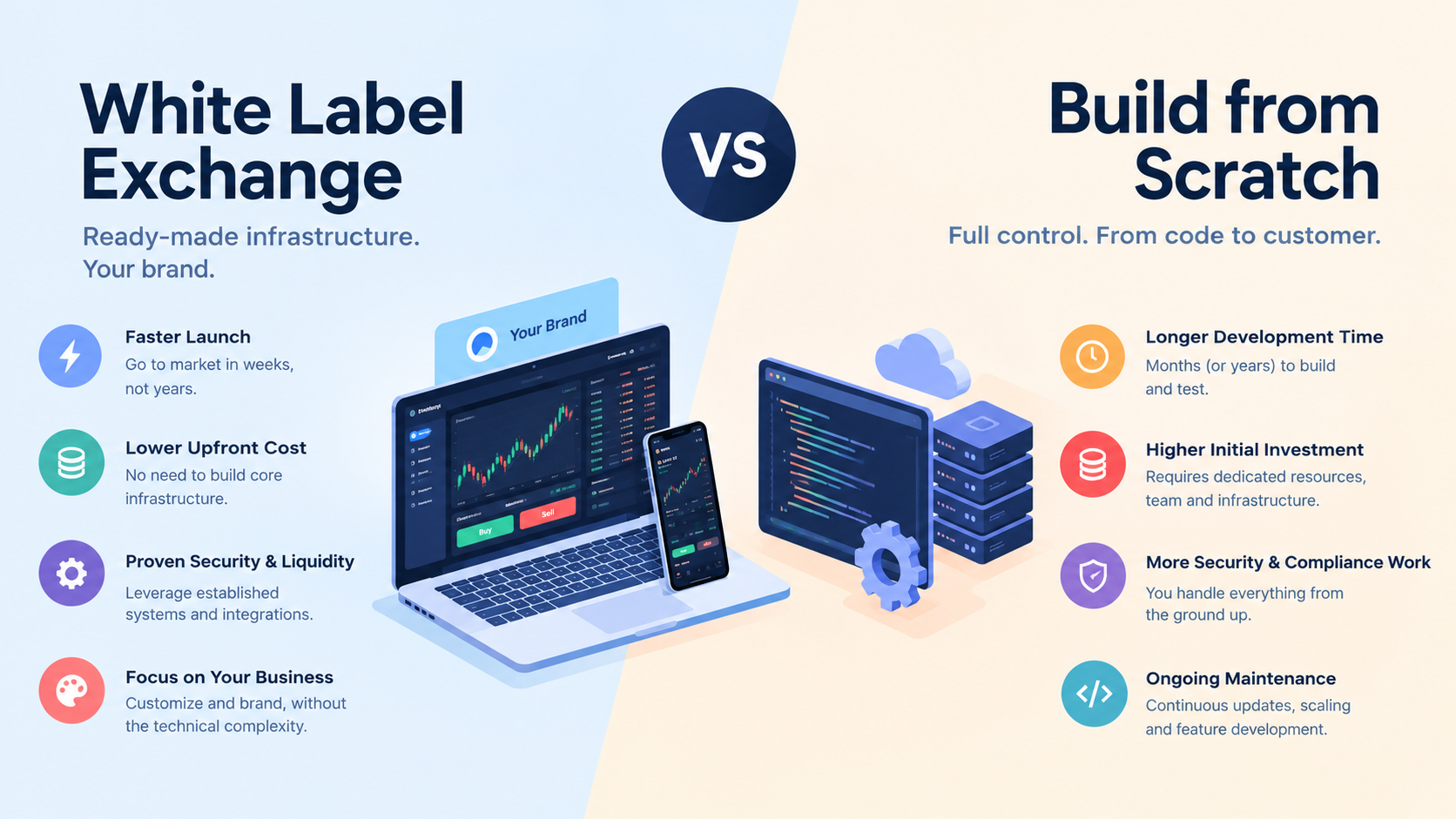
White Label vs. Building an Exchange From Scratch
The biggest difference between the two approaches is the amount of infrastructure the business must build and maintain itself.
A custom exchange requires the development of the core trading engine, wallets, APIs, security architecture, user interfaces, administrative systems, and supporting infrastructure. A white-label platform starts with much of this technology already developed. The operator can then concentrate on branding, configuration, liquidity, compliance, integrations, operations, and customer acquisition.
For businesses requiring complete architectural control, custom development may still be the better route. But, for businesses that want to enter the market faster and reduce the burden of building every component internally, white-label infrastructure can provide a more practical starting point.
Which White Label Cryptocurrency Exchange Is Best?
There is no universal winner. The right choice depends on the business model and the level of control required.
HashCash Consultants is a strong choice for businesses seeking a configurable, full-stack exchange platform with trading, wallet, liquidity, security, and compliance-related infrastructure.
AlphaPoint is better aligned with institutions that prioritize performance, risk controls, and exchange infrastructure built for demanding trading environments.
B2BROKER stands out for brokerages and financial businesses that need exchange technology alongside liquidity, wallets, CRM, and client-management infrastructure.
ChainUp is worth considering for businesses looking beyond a single exchange toward a broader digital-asset technology ecosystem.
HollaEx is particularly attractive to technically capable businesses that value open-source flexibility and greater control over the technology stack.
Shift Markets can suit financial businesses looking for modular digital-asset infrastructure.
Antier is a compelling option when the exchange is expected to become part of a larger, highly customized blockchain ecosystem.
Ultimately, the strongest platform is not necessarily the one with the longest feature list. It is the one that provides the right infrastructure for the business model, target market, compliance requirements, and long-term growth strategy.
Final Takeaway
White-label cryptocurrency exchange software has evolved significantly beyond simply providing a branded trading interface. Today’s platforms can bring together matching engines, liquidity, wallets, security controls, KYC/AML infrastructure, APIs, administrative systems, mobile applications, and integrations into a single technology stack.
For businesses evaluating the market in 2026, the decision should therefore be based on more than launch speed or the number of advertised features.
Infrastructure depth, security, liquidity, customization, scalability, and operational control are what ultimately separate a convenient exchange launch from a platform capable of supporting a serious digital-asset business.



No Comment