

The digital payments landscape has evolved significantly over the past decade. Businesses are no longer operating within a single market or serving customers through one payment method. Today’s merchants must support multiple payment channels, currencies, acquiring banks, payment service providers, and customer preferences while maintaining a seamless checkout experience.
As payment ecosystems become increasingly complex, many businesses find themselves asking an important question: Is a payment gateway enough, or do they also need payment orchestration?
The reality is that payment gateways and payment orchestration platforms serve different purposes. While payment gateways remain a fundamental component of payment processing, modern businesses often require payment orchestration to optimize performance, improve transaction success rates, and create a more resilient payment infrastructure.
Understanding the differences between these technologies can help organizations build a payment strategy that supports growth, enhances customer experience, and maximizes revenue opportunities.
Understanding the Role of a Payment Gateway
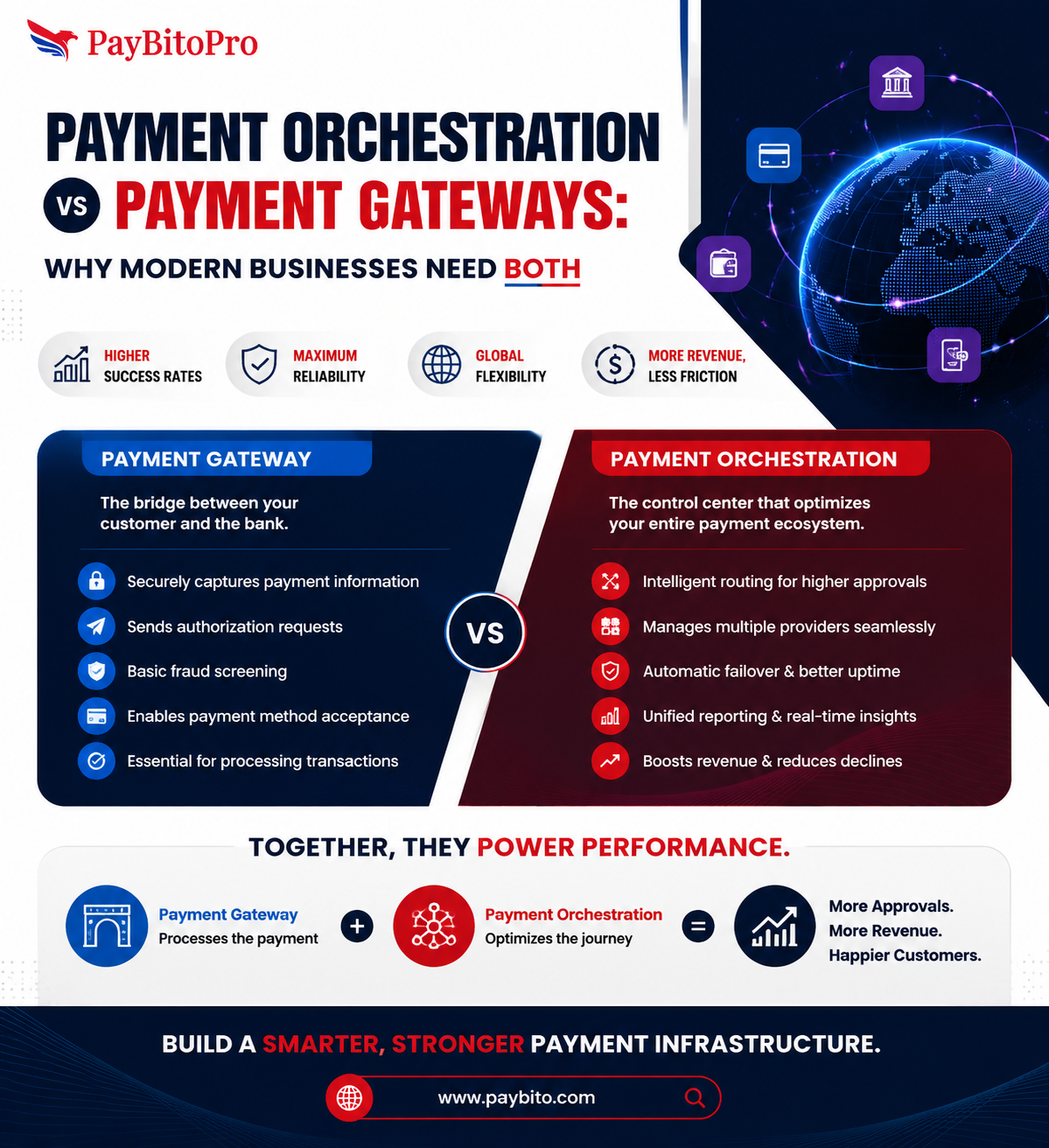
A payment gateway acts as the bridge between a customer’s payment method and the merchant’s payment processing environment.
Whenever a customer makes a purchase online, the payment gateway securely captures transaction data and transmits it to the appropriate financial institutions for authorization and processing.
In simple terms, a payment gateway enables businesses to accept digital payments.
Key functions of a payment gateway include:
- Secure transmission of payment information
- Payment authorization requests
- Fraud screening and security controls
- Transaction processing support
- Integration with merchant systems
- Payment method acceptance
Without a payment gateway, online businesses would struggle to process card payments, digital wallets, bank transfers, and other electronic payment methods.
For many small businesses, a single payment gateway may provide sufficient functionality during the early stages of growth. However, as transaction volumes increase and operations expand internationally, new challenges often emerge.
The Limitations of Relying on a Single Payment Gateway
While payment gateways are essential, they are not designed to solve every payment-related challenge.
A business relying solely on one payment gateway may encounter several operational issues:
Single Point of Failure
If the gateway experiences downtime, service disruptions, or technical issues, transaction processing can be affected immediately.
Limited Geographic Coverage
Not all payment providers perform equally across regions. A gateway that works effectively in one country may deliver lower authorization rates elsewhere.
Reduced Payment Flexibility
Customers increasingly prefer different payment methods depending on their location. A single gateway may not support all preferred options.
Revenue Loss from Failed Transactions
Even small declines in payment authorization rates can result in significant revenue losses over time.
Scaling Challenges
As businesses grow, managing multiple payment providers through separate integrations becomes increasingly complex and resource-intensive.
These challenges have contributed to the growing adoption of payment orchestration solutions.
What Is Payment Orchestration?
Payment orchestration is a technology layer that sits above payment gateways, processors, acquirers, and other payment service providers.
Instead of connecting directly to a single provider, businesses use a payment orchestration platform to manage multiple payment partners through a unified infrastructure.
Think of payment orchestration as the control center of a payment ecosystem.
Rather than replacing payment gateways, it coordinates and optimizes how they operate.
Core capabilities typically include:
- Intelligent transaction routing
- Multi-provider management
- Payment method optimization
- Unified reporting and analytics
- Fraud management integration
- Automated failover mechanisms
- Cross-border payment optimization
- Compliance management support
Payment orchestration allows businesses to create a flexible and scalable payment architecture that adapts to changing market requirements.
Payment Gateway vs Payment Orchestration: The Key Differences
Although these terms are sometimes used interchangeably, they perform very different functions.
Payment Gateway
A payment gateway focuses on processing transactions.
Its primary responsibility is to securely transfer payment information and facilitate authorization requests between customers, merchants, and financial institutions.
Primary objectives include:
- Payment acceptance
- Transaction authorization
- Data security
- Basic fraud prevention
Payment Orchestration
Payment orchestration focuses on managing and optimizing the entire payment ecosystem.
Rather than processing payments directly, it determines how payments should be routed, which providers should be used, and how payment performance can be improved.
Primary objectives include:
- Transaction optimization
- Provider management
- Revenue protection
- Payment flexibility
- Operational efficiency
A useful analogy is that the payment gateway functions as a vehicle, while payment orchestration acts as the navigation system determining the best route to reach the destination.
Why Modern Businesses Need Both
As payment environments become increasingly sophisticated, relying on either solution alone may not provide sufficient flexibility.
Modern businesses often benefit from combining payment gateways with payment orchestration platforms.
Improved Transaction Success Rates
Different payment providers often perform differently depending on geography, card issuer, payment type, and transaction characteristics.
Payment orchestration can automatically route transactions to the provider most likely to approve them.
Benefits include:
- Higher authorization rates
- Reduced transaction declines
- Improved customer satisfaction
- Increased revenue capture
Enhanced Business Continuity
Downtime can have a direct impact on sales and customer trust.
Payment orchestration platforms can automatically redirect transactions when a payment provider becomes unavailable.
This redundancy helps businesses maintain uninterrupted payment acceptance.
Better Global Payment Coverage
International expansion often requires support for:
- Regional payment methods
- Multiple currencies
- Local acquiring banks
- Country-specific compliance requirements
Payment orchestration enables businesses to integrate multiple providers while managing them through a centralized system.
Simplified Payment Operations
Managing separate integrations for numerous payment providers can become operationally burdensome.
Payment orchestration reduces complexity by creating a single integration layer across the payment ecosystem.
This simplifies:
- Provider onboarding
- Reporting
- Monitoring
- Payment management
- Compliance workflows
The Business Impact of Payment Optimization
Many organizations underestimate the financial impact of payment optimization.
A small increase in payment approval rates can produce substantial revenue gains, particularly for businesses processing large transaction volumes.
Payment orchestration helps businesses optimize areas such as:
Revenue Recovery
Failed payments do not always indicate insufficient funds or fraud concerns.
Many declines occur because transactions are routed inefficiently.
Intelligent routing can recover transactions that might otherwise fail.
Customer Experience
Consumers expect fast, frictionless payment experiences.
When payments fail unexpectedly, customers may abandon purchases and choose competitors.
Improved payment performance contributes directly to higher conversion rates.
Cost Management
Different payment providers often have varying fee structures.
Payment orchestration can help businesses route transactions more efficiently while balancing performance and cost considerations.
The Growing Demand for Flexible Payment Infrastructure
As businesses expand into new markets, payment flexibility becomes increasingly important.
Organizations require infrastructure capable of adapting to:
- New payment methods
- Regulatory changes
- Emerging technologies
- Market-specific preferences
- Increasing transaction volumes
This is driving demand for customizable payment ecosystems that provide greater control over payment operations.
Businesses seeking to build scalable payment environments often explore solutions such as white-label payment gateway infrastructure that enables organizations to launch and manage payment services under their own brand.
In addition, companies processing digital asset transactions increasingly require payment solutions capable of supporting both traditional and blockchain-based payment flows through a unified framework.
Organizations looking to establish fully branded payment platforms can also leverage white-label financial infrastructure designed to support customized payment experiences and business-specific requirements.
Choosing the Right Payment Strategy
There is no universal payment model that works for every business.
The appropriate approach depends on several factors:
- Transaction volume
- Geographic footprint
- Customer demographics
- Industry requirements
- Payment method diversity
- Growth objectives
For smaller businesses, a payment gateway may initially provide sufficient functionality.
However, as payment operations become more complex, payment orchestration can help unlock greater efficiency, resilience, and scalability.
Companies planning long-term growth should evaluate not only how they accept payments today but also how their payment infrastructure will support future expansion.
Conclusion
Payment gateways and payment orchestration platforms are not competing technologies. They are complementary components of a modern payment ecosystem.
Payment gateways enable businesses to accept and process transactions securely. Payment orchestration platforms optimize how those transactions move through the broader payment infrastructure.
As customer expectations rise and global payment environments become more complex, businesses increasingly require both capabilities to remain competitive.
Organizations that combine robust payment gateway functionality with intelligent payment orchestration gain greater flexibility, higher authorization rates, improved operational efficiency, and stronger resilience against payment disruptions.
In an era where payment performance directly influences customer experience and revenue growth, modern businesses need more than payment acceptance alone. They need a payment infrastructure capable of adapting, optimizing, and scaling alongside their ambitions—and that is precisely why payment gateways and payment orchestration are most effective when working together.

No Comment