

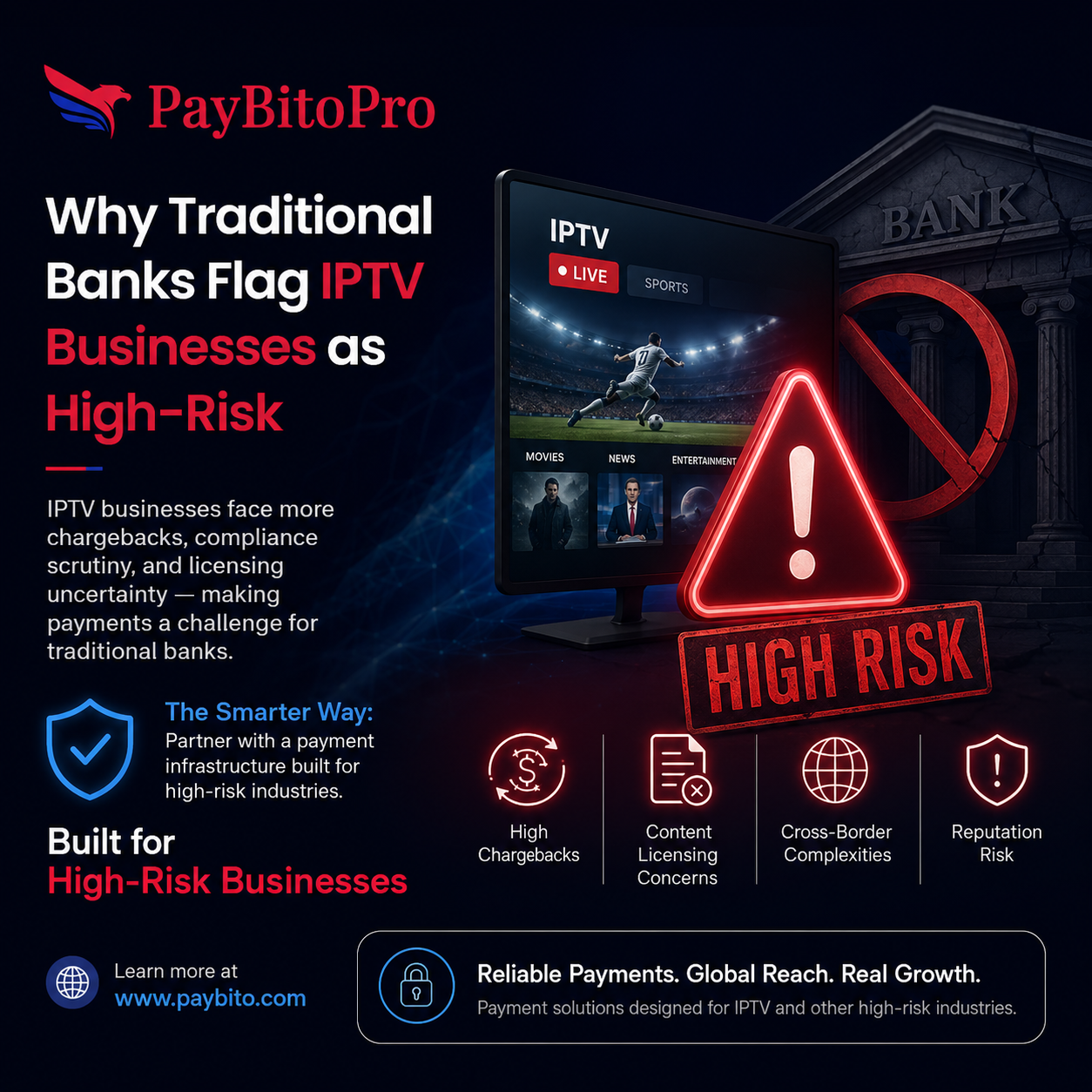
The IPTV industry has transformed how audiences consume entertainment. Instead of relying on cable infrastructure, viewers can access television channels, live sports, movies, and on-demand content through internet-based streaming services. As the sector continues to grow, many IPTV operators are discovering an unexpected challenge: GETTING PAID.
While launching a streaming platform is easier than ever, securing stable payment processing remains one of the industry’s biggest obstacles. Many IPTV businesses experience declined transactions, account freezes, delayed settlements, or even complete merchant account terminations. This is one reason why specialized solutions such as PayBito’s IPTV payment processing infrastructure have emerged to address the unique requirements of streaming businesses.
But why exactly do traditional banks and payment processors consider IPTV businesses high-risk? Let’s examine the factors behind this classification.
Understanding the High-Risk Label
The term “high-risk” often creates confusion. Contrary to popular belief, it does not automatically mean a business is fraudulent or illegal. In the payments industry, a high-risk classification simply means a merchant presents a higher probability of financial, operational, regulatory, or reputational risk to banks and payment processors.
Industries commonly categorized as high-risk include online gaming, travel services, forex trading, subscription businesses, nutraceuticals, cryptocurrency services, and IPTV platforms.
For banks, the question isn’t whether a business is successful. The question is whether processing payments for that business could expose the institution to excessive losses or compliance issues.
Subscription Billing Creates Elevated Risk
One of the primary reasons IPTV businesses are scrutinized is their subscription-based business model.
Recurring billing introduces unique challenges:
- Customers may forget they subscribed.
- Failed renewals can trigger disputes.
- Subscribers may request refunds after consuming content.
- Chargebacks can occur months after the original transaction.
Unlike traditional retail purchases, subscription services maintain ongoing billing relationships with customers. Payment processors closely monitor industries with recurring revenue because chargeback rates tend to be higher than average. Industry discussions among payment professionals consistently identify recurring billing as a major reason IPTV merchants face increased scrutiny.
Content Licensing Concerns
Perhaps the biggest factor influencing risk assessments is content licensing. IPTV itself is a legitimate technology. In fact, researchers describe IPTV as a modern method of delivering television content through internet networks, enabling flexible and personalized viewing experiences. However, banks often struggle to distinguish between properly licensed IPTV operators and those distributing content without authorization.
As payment providers can face legal and reputational consequences, they facilitate transactions connected to copyright violations, many institutions adopt a cautious approach. Rather than evaluating every IPTV provider individually, some banks classify the entire category as high-risk. Payment industry discussions frequently cite content rights uncertainty as a major reason IPTV businesses lose processing privileges.
Chargebacks Are a Processor’s Worst Nightmare
Chargebacks are one of the most expensive problems in payment processing.
When a customer disputes a transaction, the merchant may lose:
- The original revenue
- The product or service delivered
- Chargeback fees
- Additional compliance costs
For IPTV businesses, disputes commonly arise from:
- Unauthorized family purchases
- Subscription misunderstandings
- Service interruptions
- Billing descriptor confusion
- Customer dissatisfaction
A sustained increase in chargeback ratios can trigger account reviews, reserve requirements, or merchant account termination. This is one of the reasons payment processors monitor streaming businesses so closely. Industry analyses note that elevated chargeback rates remain among the biggest operational challenges for IPTV providers.
Cross-Border Transactions Increase Complexity
Many IPTV operators serve customers across multiple countries.
While global reach creates significant revenue opportunities, it also introduces additional payment risks:
- Foreign card fraud
- Currency conversion issues
- Regional compliance requirements
- Higher dispute rates
- Sanctions screening obligations
Banks must comply with ANTI-MONEY LAUNDERING (AML) and KNOW YOUR CUSTOMER (KYC) regulations across multiple jurisdictions. As a result, international subscription businesses often receive additional scrutiny during underwriting.
Modern payment infrastructure providers increasingly focus on helping businesses accept payments across numerous regions while maintaining compliance standards and operational visibility.
Reputation Risk Matters More Than Most Merchants Realize
Banks are highly sensitive to reputation.
Even if an IPTV business is operating legally, the perception of risk can influence approval decisions.
Financial institutions evaluate questions such as:
- Could this merchant attract regulatory attention?
- Could customer complaints increase?
- Could card networks impose penalties?
- Could media coverage damage the bank’s reputation?
In many cases, the reputational risk associated with content-related disputes becomes just as important as the financial risk itself.
What IPTV Operators Can Do to Improve Approval Odds
Although banks may classify IPTV as high-risk, operators are not powerless.
Several best practices can significantly improve credibility:
- Maintain clear content licensing documentation.
- Publish transparent refund and cancellation policies.
- Use accurate billing descriptors.
- Implement strong fraud prevention tools.
- Monitor chargeback ratios closely.
- Maintain detailed KYC and compliance records.
- Provide responsive customer support.
Payment performance is often determined long before the first transaction occurs. Well-structured businesses typically experience fewer payment disruptions than those that neglect compliance and customer communication.
The Future of IPTV Payments
As streaming consumption continues to expand worldwide, payment infrastructure for IPTV businesses is evolving alongside it.
Many operators are moving toward Diversified Payment Strategies that combine traditional card processing, digital wallets, and alternative payment methods to reduce dependence on any single channel. Payment platforms like Paybito focus on infrastructure flexibility, merchant control, and global transaction capabilities and are becoming increasingly relevant for businesses operating in complex industries.
Ultimately, traditional banks do not flag IPTV businesses as high-risk because IPTV technology itself is problematic. They do so because recurring billing, chargebacks, content licensing uncertainty, compliance obligations, and reputational concerns create a risk profile that requires greater oversight.
For IPTV operators, understanding these factors is the first step toward building a resilient payment strategy – one that supports growth without being derailed by unexpected payment disruptions.


scot william
Informative article explaining IPTV payment risks. Helpful insights! Also check https://flashtoolss.com/fake-usdt-sender/ for related payment technology.