

Customer churn is one of the biggest challenges facing subscription-based businesses today. Whether you’re running a SaaS platform, membership service, streaming platform, or e-commerce subscription model, losing customers directly impacts recurring revenue, growth projections, and profitability.
However, not all churn happens for the same reasons. Some customers actively decide to leave, while others are lost due to payment failures and billing issues despite having no intention of canceling. Understanding the distinction between voluntary and involuntary churn is critical for building an effective customer retention strategy.
As subscription businesses increasingly rely on digital billing systems, solutions like Subscriptions & Recurring Payments have become important for managing recurring transactions and reducing revenue leakage.
By understanding both types of churn, businesses can identify where revenue is being lost and implement strategies to recover it.
What Is Customer Churn?
Customer churn refers to the percentage of customers who stop doing business with a company during a specific period. For subscription-based businesses, churn is often measured by the number of users who cancel their subscriptions or fail to renew their services.
While acquiring new customers is essential, retaining existing customers is often more cost-effective and profitable. High churn rates can significantly increase customer acquisition costs and reduce overall business growth.
Why Churn Matters
- Reduces recurring revenue
- Increases customer acquisition costs
- Impacts revenue forecasting
- Slows long-term business growth
- Lowers customer lifetime value (CLV)
Even a small increase in churn can create substantial revenue losses over time, especially for businesses that depend on recurring billing models.
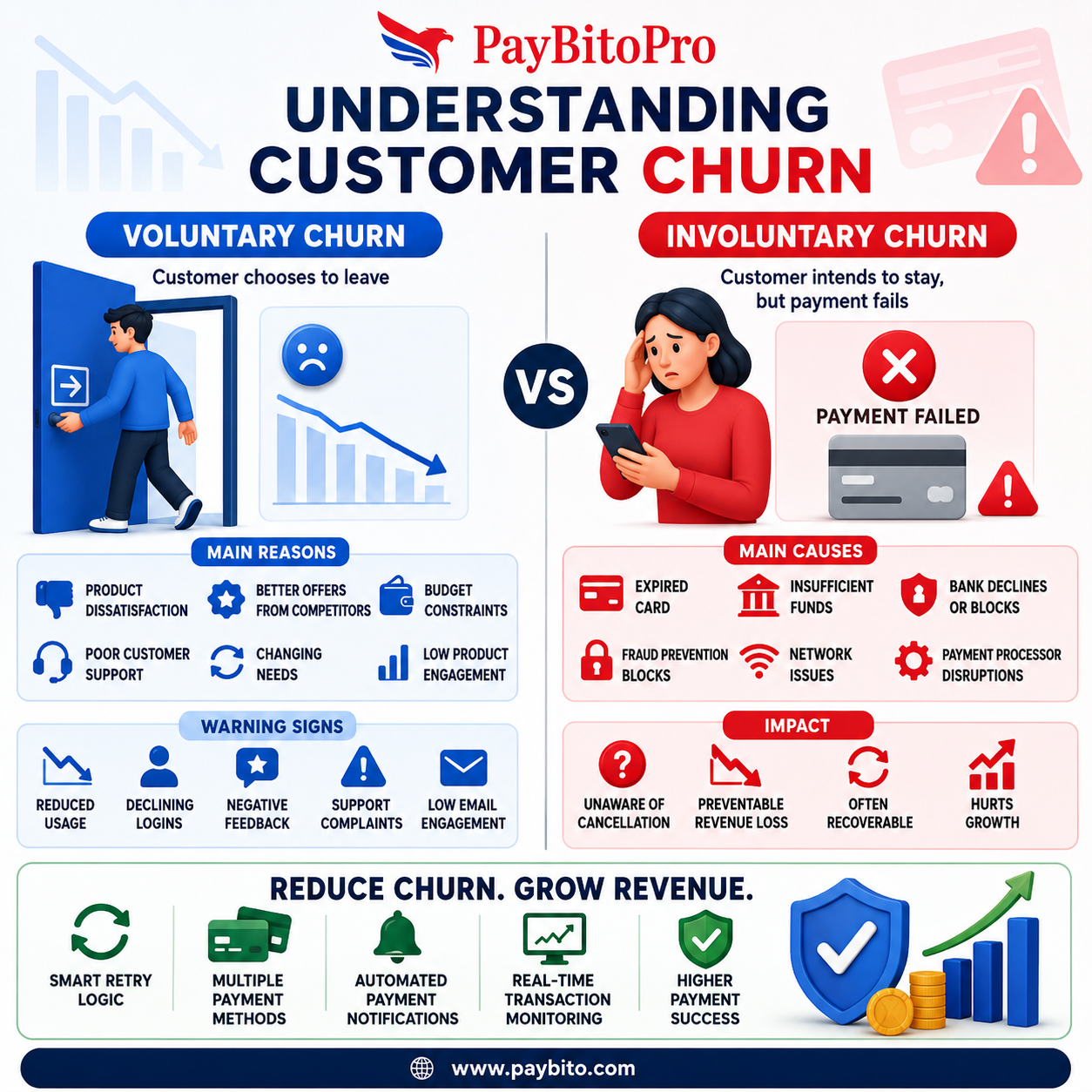
What Is Voluntary Churn?
Voluntary churn occurs when a customer intentionally decides to stop using a product or service. In this scenario, the customer actively cancels their subscription because they no longer see enough value in continuing the relationship.
Common reasons for voluntary churn include:
- Product dissatisfaction
- Better offers from competitors
- Budget constraints
- Poor customer support
- Changing customer needs
- Lack of product engagement
For example, a SaaS customer may cancel after finding a cheaper alternative, or a streaming subscriber may discontinue service because they are no longer consuming the content. Voluntary churn is often influenced by customer experience and perceived value.
Warning Signs of Voluntary Churn
Businesses can often identify voluntary churn risks before cancellations occur.
Some common indicators include:
- Reduced product usage
- Declining login frequency
- Negative customer feedback
- Increased support complaints
- Lower engagement with emails or promotions
Monitoring these signals can help businesses intervene before customers decide to leave.
What Is Involuntary Churn?
Involuntary churn occurs when customers are lost due to payment-related issues rather than intentional cancellation.
Unlike voluntary churn, the customer often wants to continue using the service but cannot because a transaction fails. This type of churn is frequently overlooked despite its significant impact on recurring revenue.
Common causes include:
- Expired credit or debit cards
- Insufficient account funds
- Bank authorization declines
- Fraud-prevention blocks
- Network connectivity issues
- Payment processor disruptions
Consider a customer who has used a subscription service for years. If their card expires and the payment cannot be processed, the subscription may be suspended or canceled automatically. The customer may not even realize what happened until after access is lost.
For many subscription businesses, involuntary churn represents one of the most preventable forms of revenue loss.
Involuntary vs. Voluntary Churn: Key Differences
|
Factor |
Voluntary Churn |
Involuntary Churn |
|
Customer Intent |
Customer chooses to leave |
Customer intends to stay |
|
Main Cause |
Product, pricing, or service issues |
Payment failures and billing issues |
|
Customer Awareness |
Usually aware of cancellation |
Often unaware of payment failure |
|
Recovery Difficulty |
Can be challenging |
Often recoverable |
|
Revenue Impact |
Long-term customer loss |
Preventable revenue leakage |
|
Prevention Strategy |
Improve customer experience |
Optimize payment infrastructure |
Although both types affect revenue, involuntary churn is often easier to recover because the customer relationship is still intact.
Why Payment Infrastructure Plays a Critical Role in Churn Reduction
Many businesses invest heavily in customer acquisition and product development but overlook the payment experience. An ineffective payment infrastructure can create friction that leads directly to involuntary churn.
Modern payment systems help businesses reduce failed transactions through:
Smart Retry Logic
Not all payment failures are permanent. Intelligent retry mechanisms can automatically reattempt failed transactions at optimal times, improving authorization success rates.
Multiple Payment Methods
Offering various payment options increases the likelihood that customers can successfully complete recurring transactions.
Automated Billing Notifications
Payment reminders help customers update expired cards or resolve account issues before service interruptions occur.
Real-Time Transaction Monitoring
Early detection of failed payments enables businesses to take immediate corrective action.
Platforms focused on accepting payments globally can help businesses streamline recurring billing operations while minimizing disruptions caused by payment failures. By optimizing payment workflows, companies can significantly reduce involuntary churn and protect recurring revenue streams.
Strategies to Reduce Both Types of Churn
Successful retention strategies address both customer experience and payment performance.
Reducing Voluntary Churn
- Improve onboarding experiences
- Continuously gather customer feedback
- Enhance product value
- Offer flexible subscription plans
- Deliver responsive customer support
When customers clearly understand the value they receive, they are more likely to remain loyal.
Reducing Involuntary Churn
- Implement automated payment retries
- Send payment failure alerts
- Offer multiple payment methods
- Use card updating services
- Monitor payment performance metrics
- Optimize payment authorization rates
Small improvements in payment success rates can have a measurable impact on recurring revenue.
The Hidden Cost of Ignoring Involuntary Churn
Many businesses focus almost entirely on customer satisfaction while overlooking payment-related revenue loss.
This creates a blind spot.
A customer may love the product, recommend it to others, and fully intend to continue their subscription. Yet a single failed transaction can end that relationship.
Unlike voluntary churn, which often requires significant improvements in product experience, involuntary churn can frequently be reduced through operational and payment infrastructure enhancements. As subscription economies continue to expand, businesses that prioritize payment optimization will be better positioned to protect revenue and improve customer retention.
Conclusion
Understanding the difference between voluntary and involuntary churn is essential for any business that relies on recurring revenue.
Voluntary churn occurs when customers intentionally leave due to dissatisfaction, changing needs, or competitive alternatives. Involuntary churn happens when customers are lost because of preventable payment failures. Both forms of churn affect growth, profitability, and customer lifetime value. However, involuntary churn often represents one of the most overlooked opportunities for revenue recovery.
Businesses that combine strong customer experiences with robust payment operations are better equipped to reduce churn and maximize retention. Solutions focused on reducing payment failures can help organizations improve transaction success rates, recover otherwise lost revenue, and create a more seamless subscription experience for their customers.
Ultimately, the most effective retention strategy is not simply keeping customers happy – it is ensuring they can continue paying without interruption.

No Comment