

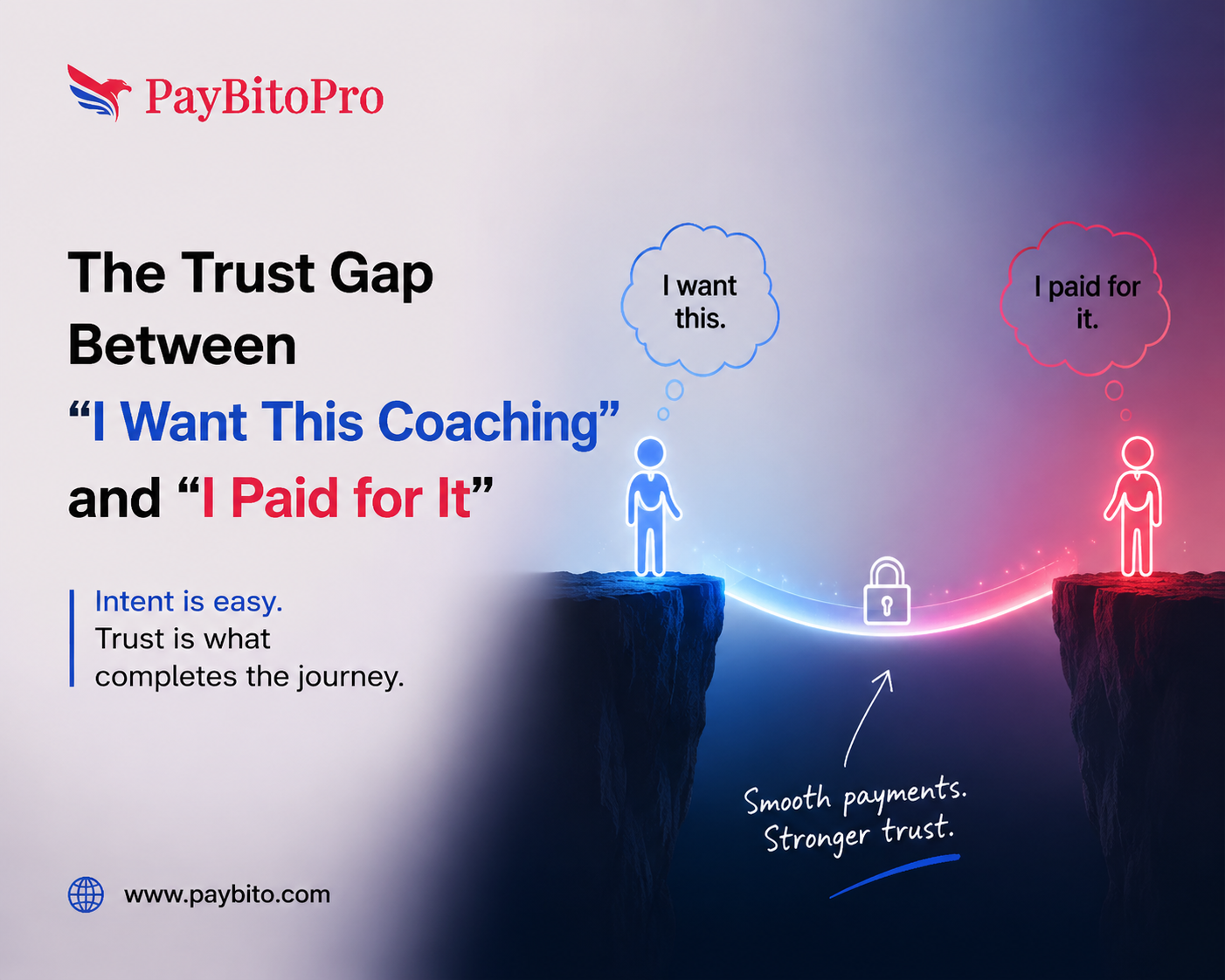
There is a very specific moment in every coaching or online learning journey that rarely gets talked about. It is not the discovery call, and it is not the transformation result. It is the quiet, almost invisible moment between intent and payment – where motivation is high, but trust is still fragile.
For life coaches, business coaches, and online course creators, this gap is often where potential clients disappear without explanation. Not because they lost interest, but because something subtle broke the flow between decision and transaction. Understanding this emotional space is exactly where modern systems like coaching payment processing solutions begin to matter – not as tools, but as silent trust-builders in a very human decision-making process.
The Moment Right Before Payment: Where Emotion Peaks
When someone decides to invest in coaching or an online program, they are usually at a high emotional point. They’ve identified a problem. They believe the solution is real. They are ready to change something in their life or business.
But right after that decision, something shifts.
The energy of inspiration gets replaced by hesitation – not always conscious, but very real. Questions begin to appear:
- “Am I making the right choice?”
- “Is this worth it for me personally?”
- “What if this doesn’t work for me specifically?”
- “Do I trust this process enough to commit financially?”
This is not resistance to coaching itself. It is the natural human response to committing money to something intangible. Unlike buying a product you can touch, coaching is built on trust, expectation, and future transformation.
And that is where the trust gap quietly opens.
Why the Payment Step Carries More Emotional Weight Than Expected ?
Many coaching businesses assume the payment page is a formality. In reality, it is the first physical action a client takes after an emotional decision. That shift – from THINKING to PAYING – is where uncertainty becomes visible.
Even small friction points can amplify doubt:
- A slow or confusing checkout page
- Too many steps before confirmation
- Lack of clarity around what happens next
- Fear of being locked into something irreversible
- Uncertainty about support or delivery
Research on checkout behavior shows that even small friction points can significantly impact conversion rates, especially in high-intent purchases. Studies on checkout optimization highlight how streamlined payment flows directly improve completion rates in digital transactions.
This is why coaching payment processing is not just a technical layer. It becomes part of the emotional experience. A smooth, transparent flow reinforces trust. A broken or clunky one quietly erodes it. And in many cases, clients don’t complain when something feels off. They simply leave.
The Silent Psychology of “I’ll Do It Later”
One of the most underestimated behaviors in coaching sales is postponement at the payment stage. When a client says “I’ll do it later,” it rarely means later. It usually means the emotional momentum has dropped just enough for doubt to take over.
Unlike physical products, coaching decisions are rarely urgent in a survival sense. That means any interruption – technical or emotional – can reset the entire decision cycle. This is why even highly interested clients fail to convert after expressing strong intent. It is not rejection. It is emotional cooling.
At this point, even external systems matter more than businesses realize. Platforms that are built with smoother payment processing infrastructure help reduce this gap by minimizing friction and maintaining continuity between intent and action, without forcing the client to “re-decide” their purchase multiple times.
When Trust Breaks Silently, Businesses Don’t See It
One of the hardest parts about this gap is that it is invisible.
If a client abandons checkout, there is no emotional feedback. No message saying “I was interested but got uncertain.” No explanation of why the moment passed.
From the business side, it just looks like:
- “They didn’t complete payment.”
- “They dropped off at the checkout.”
- “We lost another lead.”
But from the client side, the experience can feel very different:
- “Something didn’t feel right.”
- “I need more time.”
- “I’m not sure this is for me anymore.”
That emotional disconnect is where revenue quietly disappears without any obvious pattern which is because coaching businesses are often built on trust and relationships and this silent loss can feel even more confusing. The assumption becomes that the offer needs improving, when in reality, the friction may have happened at the transaction layer itself.
The Role of Seamless Experience in Restoring Confidence
A strong coaching offer doesn’t end at persuasion. It extends into the payment experience itself. When the transition from decision to payment feels seamless, something subtle happens in the client’s mind: REASSURANCE replaces HESITATION.
Clear communication, predictable steps, and stable checkout systems create an environment where the client doesn’t have to re-evaluate their decision mid-process. Instead, they are guided gently from intent to completion.
In many modern coaching businesses, this is where operational systems quietly carry emotional weight. The better the payment experience, the less mental resistance the client experiences in completing their commitment. This is not about complexity. It is about removing unnecessary cognitive load at the exact moment when clarity matters most.
Why This Gap Matters More in High-Ticket Coaching ?
The higher the price point, the wider this trust gap becomes.
High-ticket coaching programs, business mentorships, and premium online courses all require a stronger emotional justification before payment. Clients are not just buying content – they are investing in potential transformation. That makes the payment moment even more sensitive.
Any uncertainty, no matter how small – gets magnified:
- “Is this too expensive for me right now?”
- “What if I don’t get results fast enough?”
- “Do I fully understand what I’m committing to?”
In this context, the payment experience becomes part of the reassurance process. Not through persuasion, but through stability and clarity.
Closing Reflection: Trust Is Built in Seconds, Not Just Conversations
Most coaching businesses focus heavily on building trust during marketing, content, and sales calls. But the final layer of trust is often decided in a matter of seconds – during payment.
That space between “I want this” and “I’ve paid” is not just a technical checkpoint. It is an emotional threshold. And how smoothly a business handles it can quietly define its conversion rate, client satisfaction, and long-term growth.
When that transition is handled with care, clients don’t feel like they are “completing a transaction.” They feel like they are continuing a decision they already made with confidence, and that is where thoughtful systems and infrastructure – like modern coaching payment processing environments – play a supporting role in making sure intent is not lost in hesitation, but carried forward into action.
If you want to explore how structured systems support this transition without disrupting the client experience, you can look at the coaching payment processing approach and how it is designed to reduce friction while preserving trust at the most critical moment of the journey.


No Comment