

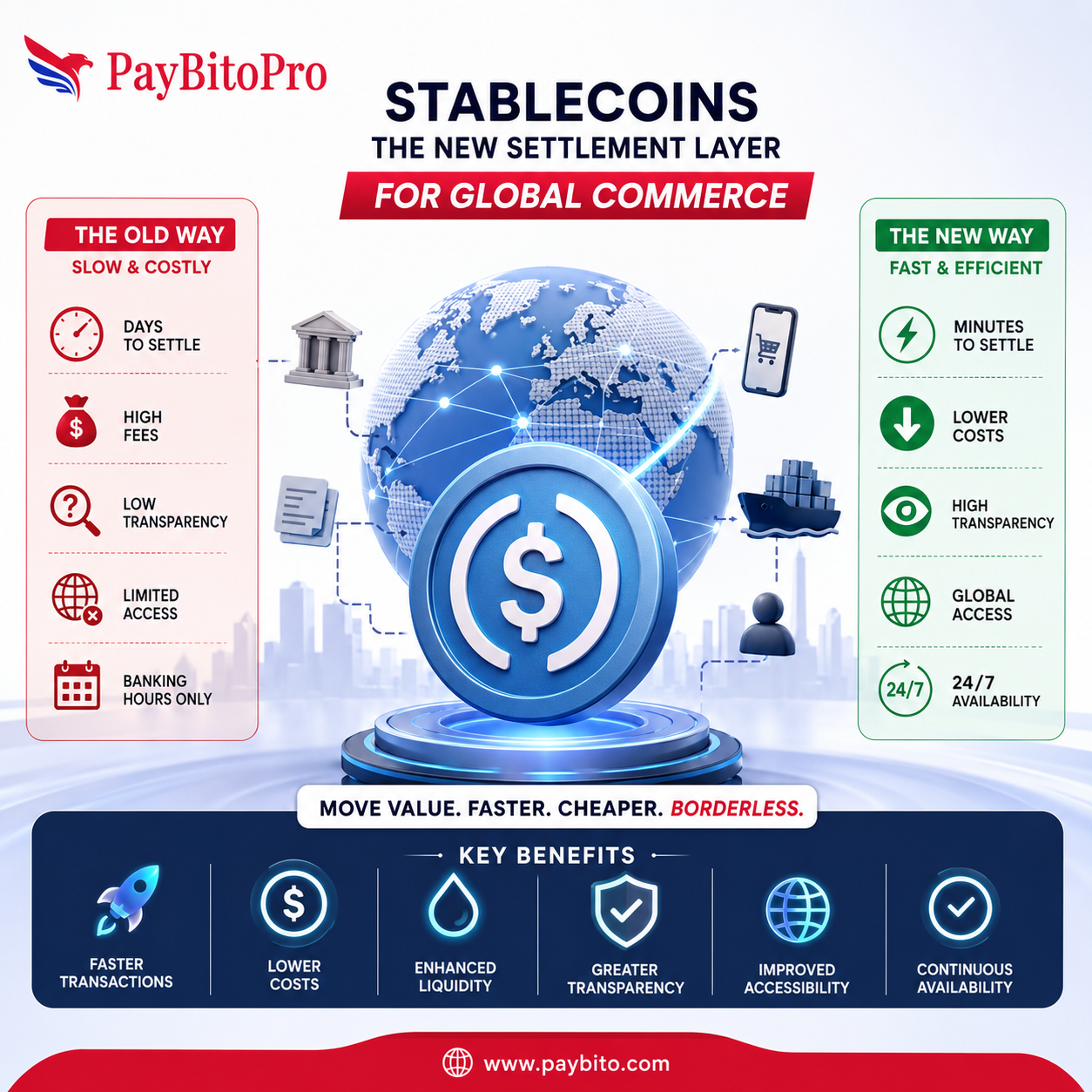
Global commerce has become increasingly digital, but the systems responsible for moving money across borders often remain slow, costly, and dependent on multiple intermediaries. Businesses can communicate instantly with suppliers, customers, and partners worldwide, yet settling payments can still take days. This growing disconnect is one reason stablecoins are gaining attention as a modern settlement solution. As blockchain-based financial tools continue to evolve, platforms such as PayBito’s crypto payment gateway reflect a broader industry shift toward faster and more efficient digital transactions.
Understanding Stablecoins
Stablecoins are digital assets designed to maintain a relatively stable value by being pegged to an underlying asset, most commonly a fiat currency such as the U.S. dollar.
Unlike cryptocurrencies that experience significant price fluctuations, stablecoins aim to provide predictability. Popular examples include USDT (Tether) and USDC (USD Coin), both of which are widely used across the digital asset ecosystem. This stability makes them particularly attractive for payments and settlements. Businesses are generally more comfortable accepting an asset that maintains a consistent value rather than one that could experience sharp price swings within hours.
As a result, stablecoins are increasingly being viewed not merely as trading instruments but as practical tools for transferring value across borders.
Why Traditional Settlement Systems Face Growing Challenges
The global financial system has facilitated international trade for decades, but it was not originally designed for the speed and connectivity demanded by today’s digital economy.
Cross-border payments often involve multiple banks, payment processors, correspondent institutions, and foreign exchange providers. Each participant adds cost, complexity, and processing time.
Common Settlement Challenges
- Slow transaction processing
International settlements can take several business days before funds become available. - High fees
Businesses often pay transaction, intermediary, and currency conversion fees. - Limited transparency
Tracking payment status across multiple institutions can be difficult. - Currency conversion costs
Exchange rate spreads can significantly impact transaction values. - Geographic restrictions
Certain markets face limited access to global financial infrastructure.
In addition, traditional systems generally operate within banking hours and are affected by weekends and public holidays, creating delays that can impact business operations and cash flow.
How Stablecoins Are Reshaping Global Commerce
Stablecoins address many of these inefficiencies by enabling value transfer directly over blockchain networks. Rather than relying on a chain of intermediaries, transactions can often be completed within minutes. This creates a more streamlined settlement experience for businesses operating internationally.
Consider a manufacturer paying overseas suppliers. Instead of waiting several days for a wire transfer to clear, stablecoin-based settlements can significantly reduce processing times. Similarly, freelancers working with international clients can receive payments faster, while eCommerce merchants can improve cash flow by reducing settlement delays.
The impact extends beyond speed. Stablecoins also offer greater transparency because blockchain transactions can be verified on public ledgers, providing clearer visibility into payment movement. As interest in blockchain-powered financial infrastructure grows, solutions such as PayBito’s digital payment infrastructure demonstrate how businesses are exploring new methods for managing global transactions more efficiently.
Furthermore, organizations worldwide are evaluating how digital assets can modernize payment systems. Research published by the Bank for International Settlements highlights the increasing importance of innovative digital settlement mechanisms in the future of global finance.
Key Benefits Driving Stablecoin Adoption
Several factors are accelerating the adoption of stablecoins across industries.
Benefits of Stablecoin Settlement
- Faster transactions
Settlements can occur much more quickly compared to traditional international transfers. - Lower costs
Reduced reliance on intermediaries can help decrease transaction expenses. - Enhanced liquidity
Businesses gain faster access to funds, improving working capital management. - Greater transparency
Blockchain records provide clearer visibility into payment activity. - Improved accessibility
Stablecoins can facilitate transactions in regions with limited banking infrastructure. - Continuous availability
Transactions can be processed 24 hours a day, seven days a week.
For global businesses, these advantages can translate into more efficient operations, improved customer experiences, and better financial flexibility.
Challenges That Still Need Attention
Despite their potential, stablecoins are not without challenges.
Regulatory frameworks continue to evolve across different jurisdictions. Governments and financial authorities are working to establish guidelines regarding issuance, reserves, compliance requirements, and consumer protection.
Reserve transparency remains another important topic. Users and businesses need confidence that stablecoin issuers maintain sufficient backing for circulating assets.
Security considerations also play a role. While blockchain technology offers significant advantages, organizations must still implement proper cybersecurity measures, wallet management practices, and compliance controls.
Additionally, interoperability between blockchain networks remains an ongoing area of development. For stablecoins to achieve widespread adoption as a global settlement layer, seamless movement across ecosystems will become increasingly important.
The Future of Stablecoins in Global Commerce
The conversation surrounding stablecoins has evolved considerably in recent years. What began primarily as a tool for cryptocurrency traders is now attracting interest from enterprises, payment providers, financial institutions, and multinational organizations.
Many experts believe stablecoins could become a foundational component of future payment infrastructure. Their ability to combine blockchain efficiency with price stability makes them well-suited for a wide range of commercial applications.
Potential use cases include:
- International trade settlements
- Corporate treasury management
- Supply chain payments
- Cross-border payroll
- Tokenized asset transactions
- Global eCommerce operations
As adoption grows, stablecoins may increasingly function as a settlement layer that connects businesses, consumers, and financial institutions across borders with fewer friction points than traditional systems.
Conclusion
Stablecoins are emerging as one of the most practical applications of blockchain technology because they address a real-world problem: the inefficiencies of global settlement systems. By offering faster transaction speeds, lower costs, enhanced transparency, and continuous availability, stablecoins are helping reshape how value moves across international markets. While regulatory and operational challenges remain, the momentum behind stablecoin adoption continues to grow.
As businesses explore the future of digital payments and financial infrastructure, platforms such as PayBito’s digital asset solutions reflect the broader evolution toward more efficient and accessible global commerce. The coming years will likely determine just how significant a role stablecoins play, but their impact on modern settlement systems is already becoming difficult to ignore.

No Comment