

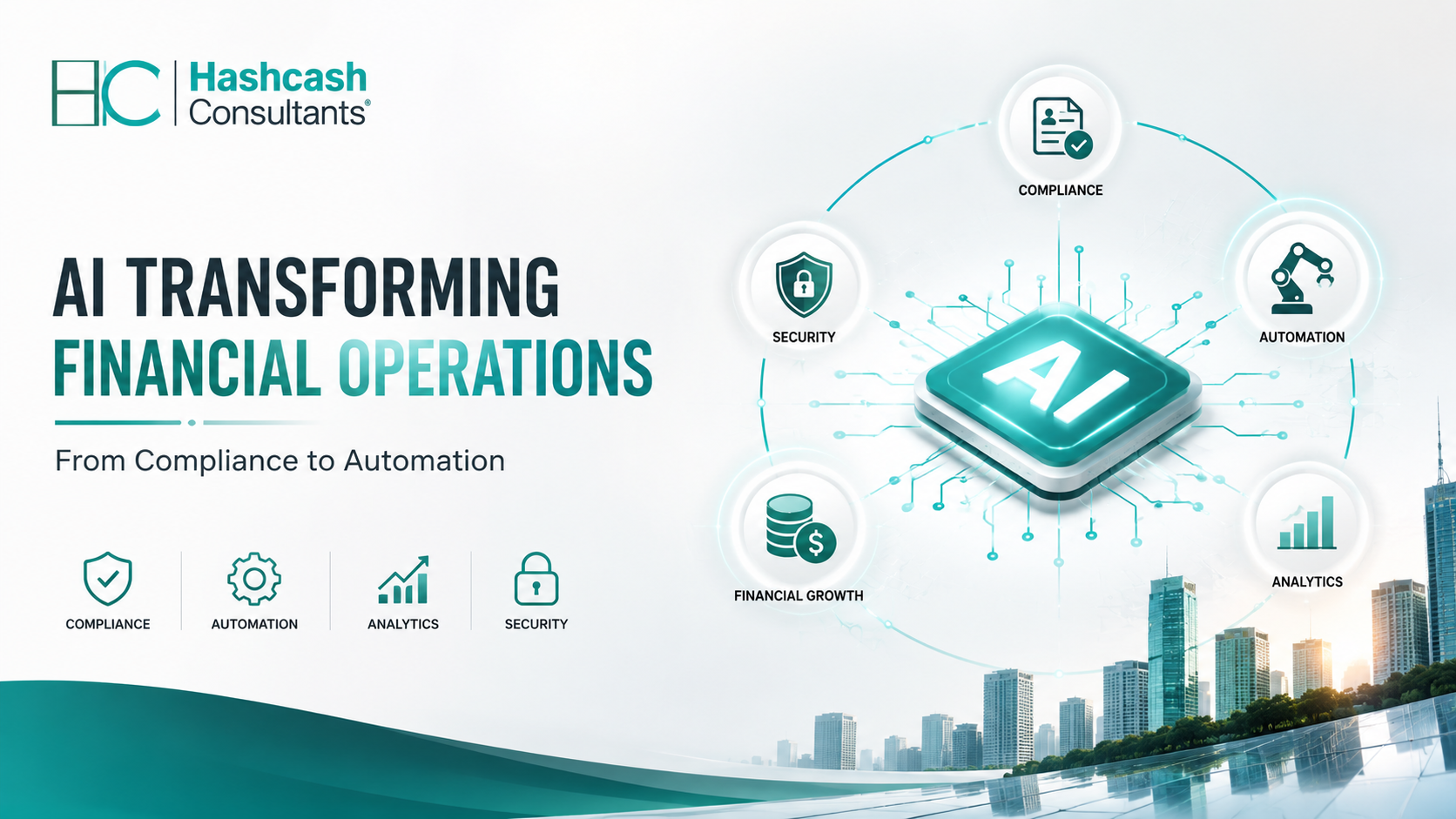
Artificial Intelligence (AI) is no longer a futuristic concept in finance – it has become a competitive necessity. Financial institutions, fintech companies, payment processors, banks, insurers, and enterprises are increasingly relying on AI to streamline operations, reduce costs, strengthen compliance, and deliver better customer experiences. From automating repetitive accounting tasks to detecting sophisticated fraud patterns in milliseconds, AI is fundamentally reshaping how financial operations are managed.
Organizations operating in highly regulated industries face mounting pressure to balance operational efficiency with ever-changing compliance requirements. This is where AI is proving invaluable. Combined with intelligent automation, machine learning, and predictive analytics, AI enables businesses to make faster decisions while reducing manual workloads and minimizing operational risk. Companies looking to modernize these processes often leverage enterprise solutions such as Digital Process Automation platform, which combines AI, Robotic Process Automation (RPA), and Business Process Management (BPM) to streamline complex financial workflows.
The Evolution of Financial Operations
Traditionally, finance departments have relied heavily on manual processes for invoice approvals, reconciliations, reporting, compliance checks, and customer verification. While these systems worked for decades, today’s digital economy generates enormous volumes of transactions that simply cannot be managed efficiently through manual intervention.
Modern financial organizations process millions of transactions daily across multiple payment channels, currencies, and jurisdictions. Human teams alone cannot monitor every anomaly, regulatory update, or fraud attempt in real time.
AI changes this equation by continuously analyzing vast datasets, identifying patterns, automating routine decisions, and alerting human teams only when exceptions require attention.
Rather than replacing finance professionals, AI augments their capabilities by allowing them to focus on strategic analysis instead of repetitive administrative work.
AI-Driven Compliance: Smarter Regulatory Management
Compliance remains one of the most resource-intensive functions within financial organizations. Regulations such as Know Your Customer (KYC), Anti-Money Laundering (AML), sanctions screening, transaction monitoring, and data privacy requirements continue to grow more complex across global markets.
AI significantly improves compliance operations by:
- Automating customer identity verification
- Monitoring transactions in real time
- Detecting suspicious behavioral patterns
- Screening against sanctions and politically exposed persons (PEP) databases
- Generating audit-ready documentation automatically
Unlike rule-based systems that depend on predefined thresholds, machine learning models continuously improve by learning from historical data and emerging fraud techniques. This adaptive capability helps compliance teams reduce false positives while improving the detection of genuine risks.
The result is faster onboarding, stronger regulatory adherence, and significantly lower operational costs.
Intelligent Automation Across Finance
Financial operations include hundreds of repetitive workflows that consume valuable employee time.
AI-powered automation now handles processes such as:
- Invoice processing
- Expense management
- Payment reconciliation
- Financial reporting
- Cash flow forecasting
- Accounts payable and receivable
- Treasury operations
Optical Character Recognition (OCR) combined with AI can extract data from invoices, validate information, detect discrepancies, and route approvals automatically. What previously required hours of manual review can now be completed within minutes with greater accuracy.
Robotic Process Automation (RPA) further enhances these capabilities by executing repetitive tasks across multiple systems without human intervention.
This creates faster workflows while reducing costly operational errors.
Fraud Detection Has Become Predictive
Financial fraud continues to evolve as cybercriminals adopt increasingly sophisticated techniques. Traditional fraud detection systems often rely on static rules, making them vulnerable to new attack methods.
AI introduces predictive intelligence.
Machine learning algorithms analyze behavioral data, device fingerprints, transaction histories, geolocation, login activity, spending habits, and network relationships to identify suspicious activity before losses occur.
Instead of simply reacting to fraud, organizations can proactively identify unusual behavior in real time and intervene immediately.
This capability is particularly valuable for payment processors, digital banks, cryptocurrency platforms, and cross-border payment providers where transaction velocity is extremely high.
Better Decision-Making Through Predictive Analytics
One of AI’s greatest strengths lies in transforming raw financial data into actionable insights.
Executives no longer need to rely solely on historical reports. AI can forecast future financial trends using predictive models built on historical performance, market conditions, customer behavior, and operational data.
Finance teams can leverage AI for:
- Revenue forecasting
- Liquidity planning
- Credit risk assessment
- Customer lifetime value prediction
- Investment analysis
- Portfolio optimization
These predictive insights enable organizations to allocate capital more efficiently while reducing financial uncertainty.
Enhancing Customer Experience
Financial operations extend beyond back-office functions.
Customers increasingly expect instant approvals, personalized services, faster support, and seamless digital experiences.
AI-powered virtual assistants and intelligent chatbots now provide:
- 24/7 customer support
- Instant account assistance
- Personalized financial recommendations
- Loan eligibility assessments
- Payment guidance
- Automated dispute resolution
Natural Language Processing (NLP) enables these systems to understand customer intent and provide context-aware responses, improving satisfaction while reducing support costs.
Challenges Organizations Must Address
Despite its advantages, AI implementation requires careful planning.
Organizations should address several important considerations:
Data Quality
AI models perform only as well as the data they receive. Inaccurate, incomplete, or inconsistent financial data can produce unreliable outcomes.
Governance
Financial institutions must establish clear governance policies for AI usage, including model validation, explainability, and auditability.
Cybersecurity
As AI systems become integrated into core financial operations, securing data pipelines and protecting sensitive financial information become increasingly important.
Human Oversight
AI should support—not replace—human expertise. Critical financial decisions should continue to include appropriate human review, especially in regulated environments. Research into AI governance consistently emphasizes explainability, traceability, and internal auditing as essential for trustworthy AI deployment in high-stakes industries.
The Future of AI in Financial Operations
The next generation of financial operations will become increasingly autonomous.
Emerging technologies such as generative AI, autonomous AI agents, advanced analytics, and intelligent workflow orchestration will continue reducing manual intervention across finance departments.
Future systems will not only process transactions but also recommend strategic decisions, identify emerging risks, automate regulatory reporting, and continuously optimize financial performance.
Organizations that begin investing in AI today will be better positioned to adapt to future regulatory requirements while maintaining operational agility.
For enterprises seeking to accelerate digital transformation consultants offer customized Artificial Intelligence Business Solutions alongside digital process automation capabilities that help organizations integrate AI into existing financial ecosystems without disrupting business continuity. Their expertise spans AI, blockchain, automation, and enterprise transformation, enabling businesses to modernize financial operations while maintaining security, compliance, and scalability. As AI adoption accelerates, partnering with experienced technology providers can significantly reduce implementation complexity and speed up measurable business outcomes.
Conclusion
Artificial Intelligence is transforming financial operations from reactive, manual processes into intelligent, automated ecosystems. Whether improving compliance, strengthening fraud detection, accelerating reporting, or enhancing customer experiences, AI delivers measurable value across every layer of financial management.
Organizations that embrace AI responsibly—supported by strong governance, quality data, and strategic implementation—will gain significant competitive advantages in efficiency, compliance, and innovation. As financial services continue evolving, AI will no longer be viewed as an optional technology but as the foundation of modern financial operations.
Frequently Asked Questions
1. How does AI improve compliance in financial operations?
AI automates KYC, AML monitoring, sanctions screening, transaction analysis, and audit reporting, helping organizations improve accuracy while reducing manual effort.
2. Can AI completely replace finance professionals?
No. AI automates repetitive tasks and provides decision support, but human oversight remains essential for strategic planning, regulatory interpretation, and complex financial decisions.
3. What financial processes benefit most from AI automation?
Invoice processing, reconciliations, fraud detection, reporting, forecasting, customer onboarding, payment processing, and expense management are among the biggest beneficiaries.
4. Is AI suitable for small and medium-sized businesses?
Yes. AI-powered financial tools are increasingly accessible and scalable, enabling businesses of all sizes to improve efficiency, reduce costs, and strengthen compliance.




No Comment