

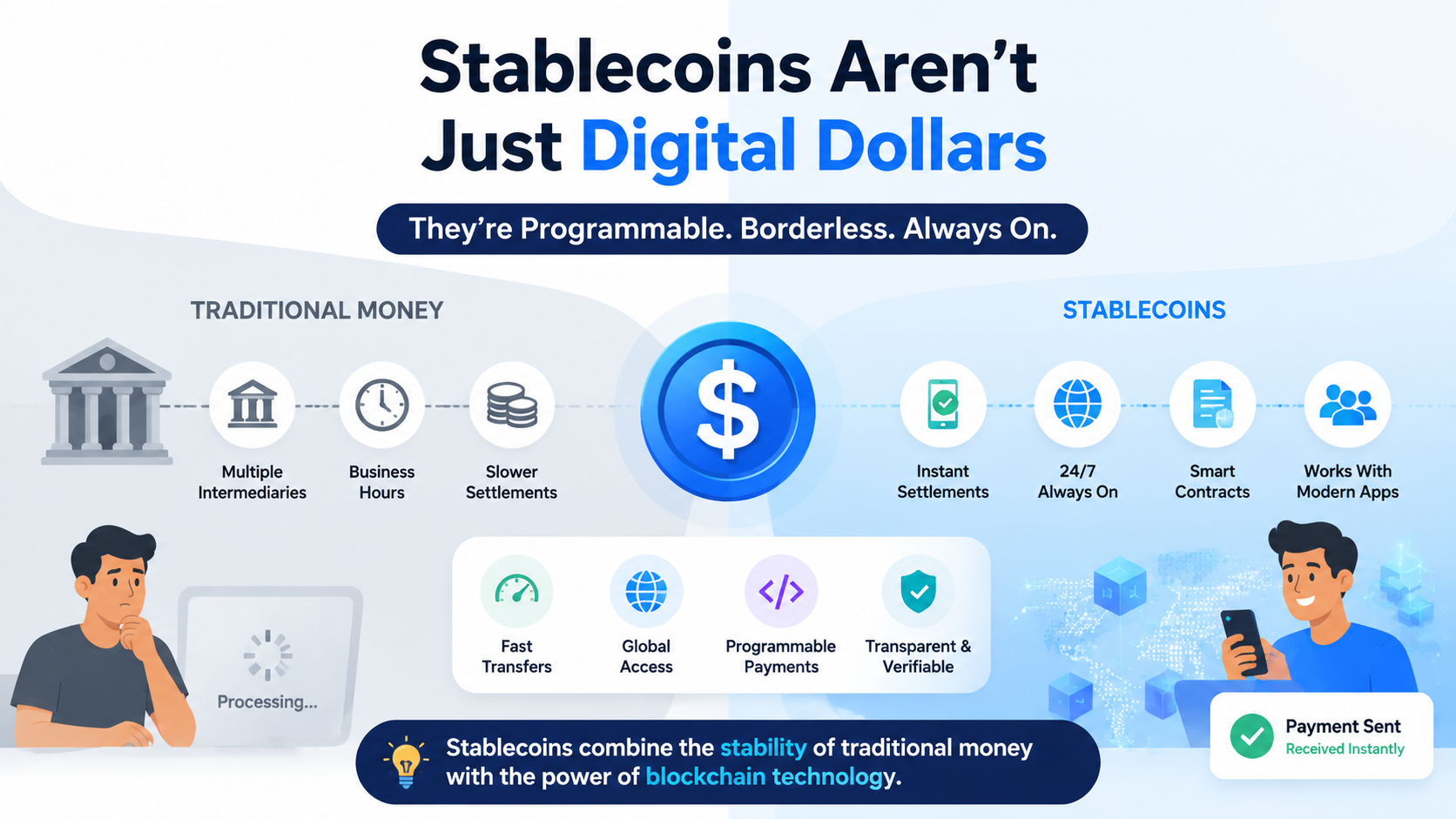
At first glance, stablecoins seem easy to understand. They are often described as digital versions of traditional currencies, designed to maintain a STABLE VALUE. For this reason people assume they are nothing more than digital dollars that exist on a blockchain.
That description is simple, but it leaves out what makes stablecoins different and why they have become such an important part of the digital asset ecosystem. A stablecoin is not just a digital representation of money. It is also a programmable financial tool that combines the stability of traditional currency with the speed and flexibility of blockchain technology.
Understanding this difference helps explain why stablecoins are used for much more than simply storing value.
A Digital Dollar Can Only Do So Much
Think about how money works in your bank account. You can send it, receive it, withdraw it, or use it to make purchases. Most of these actions depend on banks, payment providers, and business hours. Cross-border transfers may involve several intermediaries, and settlements can take days.
Now imagine that same value existing directly on a blockchain.
Instead of relying on multiple institutions to move funds, the value can be transferred from one digital wallet to another almost instantly. The blockchain itself records and verifies the transaction, making it visible and traceable without requiring every participant to trust the same financial institution. The value may still represent one dollar, but the way it moves is completely different.
Stablecoins Are Programmable Money
One of the biggest differences between stablecoins and traditional digital money is PROGRAMMABILITY.
Programmable money allows payments to follow predefined rules without requiring manual intervention. These rules are written into smart contracts, which automatically execute actions when specific conditions are met.
For example, imagine an online marketplace where a buyer orders a product from a seller in another country.
Instead of immediately releasing the payment, the stablecoins could remain locked until the shipment is confirmed. Once the delivery condition is verified, the payment is automatically sent to the seller. No one has to manually approve the transaction because the contract follows the agreed rules.
This makes financial processes more efficient while reducing delays and disputes.
If you want to understand how programmable payments work in more detail, the educational resources from the InterWork Alliance, now part of the Global Blockchain Business Council, provide useful explanations of tokenized assets and smart contracts.
Stablecoins Move Across Borders More Easily
Traditional international payments often involve several banks and payment networks before reaching the recipient. Every additional participant may introduce extra costs, longer processing times, and currency conversion fees.
Stablecoins simplify this process because the asset travels directly on the blockchain.
Imagine a freelance designer completing work for a client overseas. Instead of waiting several business days for an international wire transfer, payment can be sent digitally and received within minutes, regardless of weekends or public holidays, provided both parties have compatible wallets.
The payment is still tied to a stable value, but the infrastructure moving that value is entirely different from the traditional banking system.
They Work Beyond Banking Hours
Most banking systems follow business hours. Transactions submitted during weekends or holidays may not be processed until the next working day.
Blockchain networks, however, continue operating around the clock.
This means stablecoins can be transferred at any time without waiting for banks to reopen. For businesses operating across multiple time zones, this can improve cash flow and reduce delays in receiving funds. The ability to settle transactions continuously is one reason stablecoins have become attractive for global commerce.
Stablecoins Fit Into Automated Financial Systems
Another important distinction is that stablecoins can interact directly with decentralized applications and automated financial platforms.
For example, a logistics company could build a payment system where every completed shipment automatically triggers payment to the transporter. A subscription platform could collect recurring payments according to predefined schedules without relying on traditional card networks.
These automated workflows become possible because stablecoins exist within programmable blockchain environments rather than isolated banking databases.
In this sense, stablecoins are not simply digital cash. They become building blocks for automated financial services.
Transparency Is Built Into the System
When money moves through traditional payment systems, customers often have limited visibility into where the payment is during processing.
Blockchain transactions work differently.
Each transfer is recorded on a public ledger, allowing participants to verify that a transaction has been initiated, processed, and completed. While wallet addresses do not necessarily reveal personal identities, the transaction history itself remains visible and difficult to alter.
This transparency helps improve auditability and makes tracking fund movements much easier than in many conventional payment systems.
For readers interested in learning how blockchain transparency works, the educational guides published by the HashCash Consultants offer helpful explanations.
Stable Doesn’t Mean Risk-Free
Although stablecoins aim to maintain a consistent value, they should not be viewed as completely risk-free.
Their stability depends on how they are designed and managed. Some rely on reserves, while others use different mechanisms to maintain their target value. Factors such as reserve management, regulation, liquidity, and technology all influence their reliability.
Just because a stablecoin is designed to track a traditional currency does not automatically guarantee that it will always maintain that value under every market condition. Understanding how a stablecoin achieves stability is just as important as understanding what currency it represents.
The Bigger Picture
Calling stablecoins “digital dollars” is similar to calling the internet “digital paper”. While technically related to older systems, that description ignores the capabilities that make the technology valuable.
Stablecoins combine price stability with blockchain infrastructure, creating money that can move globally, settle continuously, interact with software, and support automated financial applications. Those characteristics extend far beyond simply digitizing an existing currency.
As blockchain technology continues to develop, stablecoins are becoming an essential layer of modern digital finance. They are not replacing traditional money overnight, nor are they trying to reinvent the concept of currency itself.
Instead, they are changing how value can move, how payments can be automated, and how financial systems can operate in a connected digital world.
That is why stablecoins are much more than “just digital dollars.” They represent a new way of using money – one that is designed not only to store value but also to make value programmable, transferable, and accessible on a global scale.



No Comment