

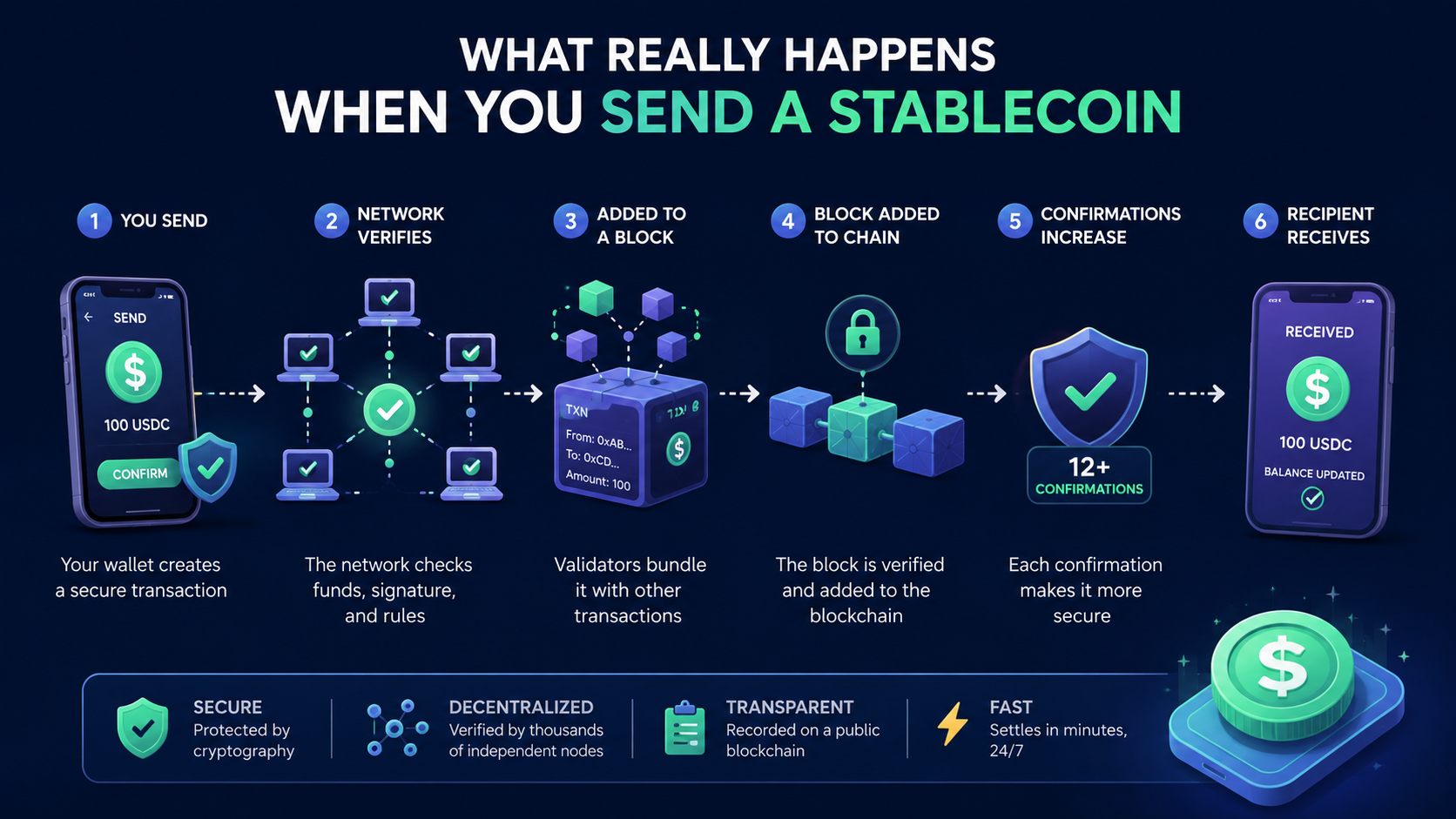
Sending a stablecoin is surprisingly simple. You open your wallet, enter the recipient’s address, choose the amount, approve the transaction, and wait a few moments. From your perspective, that’s all there is to it. But behind that simple action, an entire blockchain network works together to verify, secure, and permanently record your payment.
Unlike a traditional bank transfer, there isn’t a single institution checking your transaction or updating your balance. Instead, the network relies on cryptography, distributed computers, and shared rules to make sure every transaction is valid. Understanding this process helps explain why stablecoins have become such an important part of digital payments.
Let’s follow a stablecoin transaction from the moment you press SEND until the recipient receives the funds.
It All Starts With Your Wallet
When you send a stablecoin, your wallet doesn’t immediately transfer digital money to another wallet. Instead, it creates a transaction request that tells the blockchain what you want to do. This request contains several important details, including your wallet address, the recipient’s address, the amount being sent, and a digital signature.
The Digital Signature is one of the most important parts of the transaction. It proves that the owner of the wallet approved the payment without revealing any private information. Based on this cryptographic verification, nobody else can pretend to send funds from your wallet.
You can think of this stage like writing and signing a cheque. The cheque contains all the payment details, but the transfer isn’t complete until it reaches the banking system for verification.
The Network Checks Whether Everything Is Valid
After the transaction is created, it is broadcast to the blockchain network. Thousands of independent computers receive the information and begin checking whether it follows the network’s rules.
These computers verify several things before accepting the transaction. They confirm that the sender owns enough stablecoins, check that the digital signature is genuine, and ensure the same funds haven’t already been spent in another transaction. If any of these checks fail, the transaction is rejected.
This verification process replaces the role that banks usually play. Instead of trusting one central authority, every participant follows the same set of rules to determine whether a transaction is legitimate.
For readers interested in the technical foundation of blockchain verification, the National Institute of Standards and Technology (NIST) provides an excellent overview of how distributed ledger technology works.
Your Transaction Waits for a Block
Once the network confirms that your transaction is valid, it joins many other verified transactions waiting to be processed. These transactions are collected together into a block.
Validators then review the proposed block according to the blockchain’s consensus rules. After the network reaches agreement, the block is permanently added to the blockchain. Every transaction inside that block becomes part of a shared record that can be viewed and verified by anyone.
A simple analogy is a notebook where each completed page is permanently attached to the previous one. Once a page has been added, changing its contents would require changing every page that follows, making tampering extremely difficult.
Why Confirmations Matter
When your transaction first appears in a block, it receives its first confirmation. As new blocks continue to be added, the number of confirmations increases.
Each additional confirmation makes it increasingly difficult to reverse or alter the transaction. That’s why some wallets or applications wait for several confirmations before considering a payment complete, especially when larger amounts are involved. Although many stablecoin transfers are completed within a few minutes, the exact time depends on the blockchain network and its current level of activity.
Why You Pay a Network Fee
One question many new users ask is “why they have to pay a fee just to send a stablecoin?”.
The fee isn’t charged for moving the stablecoins themselves. Instead, it pays for the work required to process, verify, and permanently record your transaction on the blockchain. Validators prioritize transactions based partly on these fees, especially when many people are using the network at the same time.
You can compare it to sending an important document through a courier service. The document belongs to you, but you still pay for the service that securely delivers and records it.
How Is This Different From a Bank Transfer?
At first glance, sending a stablecoin feels similar to transferring money through online banking. However, the systems operating behind the scenes are very different.
|
Traditional Bank Transfer |
Stablecoin Transfer |
|
Verified by a central institution |
Verified by a blockchain network |
|
Records stored in one database |
Records shared across the network |
|
Processing may depend on banking hours |
Operates continuously |
|
Multiple intermediaries may be involved |
Direct wallet-to-wallet transfer |
|
Settlement can take days |
Settlement often happens within minutes |
These differences are one reason stablecoins are increasingly used for cross-border payments and digital financial services.
A Simple Example
Imagine you want to send 100 stablecoins to a family member living overseas. After you approve the payment, your wallet creates a digitally signed transaction and broadcasts it to the blockchain. The network checks that you own the funds, verifies your signature, and confirms that the transaction follows all the required rules.
Next, validators include the transaction in a new block, which becomes part of the blockchain. Once enough confirmations have been received, your family member’s wallet updates automatically, showing the new balance. Although the process feels almost instant to both users, several layers of security have worked together to make the payment trustworthy.
Final Thoughts
A stablecoin transaction may only take a few moments from the user’s perspective, but several important processes happen before it is complete. Your wallet creates a secure transaction, the blockchain network verifies it, validators record it in a block, and the shared ledger updates ownership after sufficient confirmations.
This combination of cryptography, decentralized verification, and transparent record-keeping is what allows stablecoins to move value without relying on a single central authority. While users only see the final result – a successful payment – the technology working behind the scenes is what makes the entire system secure and reliable.
If you’d like to learn more about the broader role of stablecoins in modern payment systems, the Bank for International Settlements (BIS) offers an informative collection of research and educational resources.


No Comment